|
 |
 |
 |
 |
 |
 |
 |
 |
 |

| . |  |
. |
Global Warming To Hit Rivers In Mediterranean, Amazon, Midwest: Study
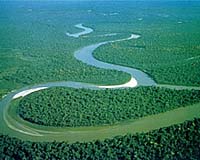
Global warming could slash the flows of rivers around the Mediterranean basin, Amazonia and the US Midwest, a phenomenon that could have resounding impacts on cities and agriculture, British scientists said here on Thursday. If the greenhouse gases that fuel global warming continue their unbraked rise, rivers in many regions of the world will be greatly affected by the end of the 21st century, said the Hadley Centre, part of the UK Met Office (meteorological service). "There are large predicted reductions in river flow across much of Europe, North Africa, Midwest America and northern South America, whilst large increases in river flow occur in West Africa, northern China and the boreal regions," they said in a report issued on the sidelines of the UN climate conference here. "Important changes in the seasonality of river flow could also occur." Scientist Vicky Pope said farmers and cities which depended on rivers for irrigation, transport and water supply "could be seriously affected," although further work was needed to predict the impact more accurately. The findings come from a new computer model, HadGEM1, put together by the Centre, located in the southwestern English city of Exeter. The model is crunched by one of the world's most powerful super-computers, capable of two million million calculations per second. Such power is essential for figuring out the impact of a wide range of variables, such as winds, rainfall patterns, ocean temperatures, soil and vegetation. Under the so-called business-as-usual scenario, emissions of carbon dioxide, the principal greenhouse gas, would continue to rise, causing global temperatures by the end of the century to rise by 3.4 C (6.1 F). This will have an impact not only on rainfall and other weather patterns, but also on vegetation, the researchers said. More CO2 causes the stomata, the leaf pores through which plants and trees breathe, to close up. As a result, the plants transpire less and give up less moisture, which they take from the ground, to the atmosphere. As a result, more water goes into the soil and ultimately ends up in rivers, increasing the flow. The Hadley researchers also concluded that there has already been a significant increase in flows into the Arctic Ocean from six big Siberian rivers -- the Yenisey, Lena, Ob, Kolyma, Pechora and Dvina. That finding backs a study by University of Southampton oceanographers, published last week, which reported a slowdown in the warm current that bathes Northwestern Europe, giving the region a relatively balmy climate for its northerly latitude. The trend could lead to a plunge in regional temperatures of between 1-2 C (1.8-3.6 F) and as much as 4 C (7.2 F) a decade from now, they said. The "brakes" acting on this current are an inrush of freshwater from the Arctic Ocean, that study suggested. Separately, a study sponsored by the environmental group Greenpeace found that global warming was badly affecting the Yellow River, dubbed China's "mother river" for its importance. "In recent years, due to climate change, the glaciers, permafrost, lakes and wetlands, and the hydrological and ecological environments in this region have undergone dramatic changes that have far-reaching implications," it said.
Source: Agence France-Presse Related Links TerraDaily Search TerraDaily Subscribe To TerraDaily Express  UN Climate Summit Marked By Warnings, US Under Fire
 Montreal (AFP) Dec 07, 2005
Warnings about climate change mingled with barbs aimed at the United States here Wednesday as the world's environment ministers wrestled with how to curb greenhouse-gas pollution. |
|
|
| The content herein, unless otherwise known to be public domain, are Copyright 1995-2016 - Space Media Network. All websites are published in Australia and are solely subject to Australian law and governed by Fair Use principals for news reporting and research purposes. AFP, UPI and IANS news wire stories are copyright Agence France-Presse, United Press International and Indo-Asia News Service. ESA news reports are copyright European Space Agency. All NASA sourced material is public domain. Additional copyrights may apply in whole or part to other bona fide parties. Advertising does not imply endorsement, agreement or approval of any opinions, statements or information provided by Space Media Network on any Web page published or hosted by Space Media Network. Privacy Statement All images and articles appearing on Space Media Network have been edited or digitally altered in some way. Any requests to remove copyright material will be acted upon in a timely and appropriate manner. Any attempt to extort money from Space Media Network will be ignored and reported to Australian Law Enforcement Agencies as a potential case of financial fraud involving the use of a telephonic carriage device or postal service. |