|
 |
 |
 |
 |
 |
 |
 |
 |
 |

| . |  |
. |
Bacteria Can Help Predict Ocean Change
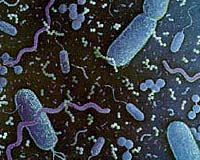
Los Angeles CA (SPX) Aug 16, 2006 Every creature has its place and role in the oceans - even the smallest microbe, according to a new study that may lead to more accurate models of ocean change. Scientists have long endorsed the concept of a unique biological niche for most animals and plants - a shark, for example, has a different role than a dolphin. Bacteria instead have been relegated to an also-ran world of "functional redundancy" in which few species are considered unique, said Jed Fuhrman, holder of the McCulloch-Crosby Chair in Marine Biology in the USC College of Letters, Arts and Sciences. In The Proceedings of the National Academy of Sciences' Early Edition, Fuhrman and colleagues from USC and Columbia University show that most kinds of bacteria are not interchangeable and that each thrives under predictable conditions and at predictable times. Conversely, the kinds and numbers of bacteria in a sample can show where and when it was taken. "I could tell you what month it is if you just got me a sample of water from out there," Fuhrman said. The researchers took monthly bacteria samples for more than four years in the Pacific Ocean near the USC Wrigley Institute's marine laboratory on Catalina Island. They used statistical methods to correlate the bacteria counts with the Wrigley Institute's monthly measurements of water temperature, salinity, nutrient content, plant matter and other variables. The researchers found they could predict the makeup of the bacterial population by the conditions in the water more than four times in five. A majority of bacterial species came and went predictably, Fuhrman said. A smaller "wild card" group in each sample was not predictable and could represent the bacterial equivalent of weeds and other redundant plants. "Wherever we looked, we found predictable kinds, but within the groups there were always less predictable and more predictable members," Fuhrman said. "They're just like animals and plants in the way they function in the system. Each one has its own place." The findings have immediate relevance for scientists attempting to understand how the oceans are changing, Fuhrman said. If bacteria behave predictably, they can be used to improve models for ocean change. By including bacteria, which make up the vast majority of species on land and sea, "we have some hope of predicting how changes are going to happen," Fuhrman said. Related Links University of Southern California  Wealthy Nations Face Water Crisis Like Poor
 Geneva (AFP) Aug 16, 2006
Wealthy nations are facing a water crisis mirroring the one experienced by drought-plagued poor countries, the environmental group WWF warned in a report Wednesday. The report, "Rich countries, poor water", said that climate change, drought, and loss of natural wetlands that store water, along with mismanagement of freshwater resources, pollution, and overconsumption by industry, agriculture and big cities were stripping supplies. |
|
|

| The content herein, unless otherwise known to be public domain, are Copyright 1995-2006 - SpaceDaily.AFP and UPI Wire Stories are copyright Agence France-Presse and United Press International. ESA PortalReports are copyright European Space Agency. All NASA sourced material is public domain. Additionalcopyrights may apply in whole or part to other bona fide parties. Advertising does not imply endorsement,agreement or approval of any opinions, statements or information provided by SpaceDaily on any Web page published or hosted by SpaceDaily. Privacy Statement |