|
 |
 |
 |
 |
 |
 |
 |
 |
 |

| . |  |
. |
NASA Magnetic Field Mission Ends
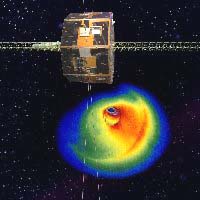
Vandenburg AFB CA (SPX) Jan 23, 2006 NASA's Imager for Magnetopause-to-Aurora Global Exploration (IMAGE) satellite recently ceased operations, bringing to a close a successful six-year mission. IMAGE was the premier producer of new discoveries on the structure and dynamics of the Earth's external magnetic field (magnetosphere) and its contents. "The IMAGE mission showed us space around the Earth is anything but empty, and that plasma clouds can be imaged and tracked just as we do from space for Earth�s surface weather," said Barbara Giles, IMAGE Program Scientist at NASA headquarters. Prior to the launch of IMAGE, the energetic particles and electrically charged gas (plasma) surrounding the Earth were completely invisible to human observers. IMAGE enabled researchers to study the global structure and dynamics of the Earth's inner magnetosphere as it responded to energy from solar winds. "Nearly six years of imagery by the pioneering cameras on IMAGE revolutionized our understanding of geospace and our knowledge of its space weather," said James Burch, IMAGE principal investigator at the Southwest Research Institute, San Antonio. IMAGE was launched on March 25, 2000. It successfully completed its two-year primary mission and continued providing data into December 2005, when it stopped responding to commands from ground controllers. Preliminary analysis indicated the craft's power supply subsystems failed, rendering it lifeless. The satellite is in an extended elliptical orbit and poses no threat to the planet. IMAGE discoveries have been reported in more than 400 peer-reviewed publications. More than 20 Ph.D. theses were based on data from the mission. Science highlights include: Confirmations: plasma plume creation, post-midnight peak in storm plasmas, the neutral solar wind, terrestrial origin of geospace storm plasmas and continuous nature of magnetic reconnection. Discoveries: plasmaspheric shoulders and notches, proton auroras in unexpected places, surprisingly slow plasmasphere rotation, a hot oxygen geocorona and a secondary interstellar neutral atom stream. Resolutions: the source of kilometric continuum radiation, solar- wind and auroral intensity effects on ionospheric out flow and the relationship between proton and electron auroras during geospace storms. The IMAGE education and public outreach program received numerous awards for videos, books, primary and secondary school curricula, teacher training, museum exhibits, planetarium shows, student workbooks and web-based information. The extensive archival database generated by IMAGE promises to yield new discoveries and will support investigations by other spacecraft and ground-based observatories for many years. IMAGE was a Medium Explorer mission sponsored by NASA's Sun-Earth Connections Program and managed by NASA's Goddard Space Flight Center, Greenbelt, Md. The Southwest Research Institute conducts IMAGE science operations. James Burch is the mission principal Investigator, and Thomas Moore at Goddard is the Mission Scientist. Related Links IMAGE mission  Winter Snow On The Hindu Kush
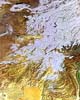 Paris, France (ESA) Jan 23, 2006
Winter snow blankets the heights of the Pamir Mountains and the Hindu Kush in this Envisat image acquired over Central Asia, the snow cover extending to surrounding desert lowlands. |
|
|

| The content herein, unless otherwise known to be public domain, are Copyright 1995-2006 - SpaceDaily.AFP and UPI Wire Stories are copyright Agence France-Presse and United Press International. ESA PortalReports are copyright European Space Agency. All NASA sourced material is public domain. Additionalcopyrights may apply in whole or part to other bona fide parties. Advertising does not imply endorsement,agreement or approval of any opinions, statements or information provided by SpaceDaily on any Web page published or hosted by SpaceDaily. Privacy Statement |