|
 |
 |
 |
 |
 |
 |
 |
 |
 |

| . |  |
. |
New Study Spells Bad News For Quake-Prone California
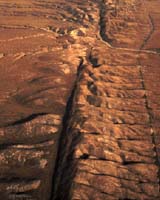
Paris (AFP) Jun 21, 2006 Southern California remains under the curse of an earthquake that may strike soon, according to a study which rules out hopes that stresses may have eased the peril posed by the notorious San Andreas fault. The San Andreas runs north-south along almost all of western California, passing through San Francisco and running just north of Los Angeles, before emerging in the far south in the San Jacinto fault. The land on western side of the San Andreas is heading north, while the eastern side is heading south - a movement called slip. But slip, between mighty opposing plates, is a rarely a smooth affair. The pent-up friction, when released, can cause cataclysmic earthquakes. But the threat can be eased if the energy is released in minor movements, known as creep. The northern segment had a major temblor, the San Francisco Earthquake, in 1906, and its central segment had a big quake in 1857. But the southern segment has not produced a great earthquake for at least 250 years, so the big question is when the next Big One will occur there. In a study published on Thursday in the British weekly journal Nature, seismologist Yuri Fialko of the Scripps Institution of Oceanography in La Jolla, California, looked at the critical question of creep in the southern section. He used satellite imaging from two European Space Agency (ESA) satellites and data from Global Positioning System (GPS) monitors deployed on the ground to get a picture of surface movement in this area from 1985 to 2005. Sadly, for the 18 million people of the Los Angeles region, Fialko has only bad news to offer. The slip rates and built-up stresses on the southern section are indeed substantial: if the two sides of the faults slid alongside each other flawlessly, they would have moved between 5.5 and seven metres (17.8 and 22.75 feet) over the last quarter of a millennium. By the data show that this cannot have happened. The accumulated energy is not being released by creep, nor is it being transmitted significantly to the shock absorber which is the San Jacinto fault to the south. Fialko emphasises that no-one can say when the Big One may strike. But, he warns, it is only logical to conclude that the southern San Andreas is near the end of its long period of dormancy - in seismological jargon, "approaching the end of the interseismic phase of the earthquake cycle."
Source: Agence France-Presse Related Links Scripps Institution of Oceanography  How Did Continents Split
 Athens OH (SPX) May 25, 2006
Like pieces in a giant jigsaw puzzle, continents have split, drifted and merged again many times throughout Earth's history, but geologists haven't understood the mechanism behind the moves. A new study now offers evidence that continents sometimes break along preexisting lines of weakness created when small chunks of land attach to a larger continent. |
|
|

| The content herein, unless otherwise known to be public domain, are Copyright 1995-2006 - SpaceDaily.AFP and UPI Wire Stories are copyright Agence France-Presse and United Press International. ESA PortalReports are copyright European Space Agency. All NASA sourced material is public domain. Additionalcopyrights may apply in whole or part to other bona fide parties. Advertising does not imply endorsement,agreement or approval of any opinions, statements or information provided by SpaceDaily on any Web page published or hosted by SpaceDaily. Privacy Statement |