|
 |
 |
 |
 |
 |
 |
 |
 |
 |

| . |  |
. |
Powerful hurricane season looms in Atlantic
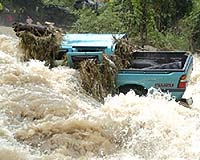
Miami (AFP) May 31, 2006 Storm-weary residents along the US Atlantic coast this week begin six months of hurricane watching and forecasters say there is every chance they will see new devastation. The season officially starts Thursday and US experts say as many as 10 hurricanes could form in the Atlantic and four could slam ashore in the southern United States. That could easily spell disaster for residents of coastal areas, thousands of whom have not yet finished repairing homes damaged by last year's Katrina, Rita and other massive storms. In addition, some 100,000 people whose homes were destroyed or severely damaged are still living in mobile homes or trailers, which offer little protection from a hurricane's destructive fury. And authorities admit they have not finished strengthening the levees that broke after Hurricane Katrina slammed into the US Gulf coast on August 29, 2005, flooding large parts of New Orleans. "We now have a much larger vulnerable population going into this hurricane season and it will not take a category three or four hurricane to devastate that citizenship," said Robert Latham, who heads the Mississippi Emergency Management Agency. A hurricane ranks at category three on the five-category Saffir-Simpson intensity scale if its packs winds of 178-209 kilometers (111-130 miles) per hour and rises to category four when its winds increase to 249 kph (155 mph). Katrina ranked as category three when it slammed ashore near New Orleans, causing the deaths of more than 1,500 people. In all, 2005 saw a record 15 hurricanes, among an unprecedented 28 named storms that formed in the Atlantic. For the first time on record, seven of the hurricanes were considered major, meaning they hit category three or higher. It was also the costliest hurricane season, with damage estimated at more than 100 billion dollars. While experts do not expect those records to be beaten this year, there is no saying whether a major hurricane might slam into a major city along the Atlantic or the Gulf of Mexico. "As bad as Katrina was, it can be worse," said Latham. He admitted areas hit by Katrina were ill-prepared to face another hurricane, despite efforts to rebuild shattered infrastructure. "Another storm would be really devastating," he said this month, when government forecasters presented a report saying the 2006 season could see between eight to 10 hurricanes develop in the Atlantic, with four to six becoming major storms. In Florida, concern rose as engineers recently suggested a major storm could smash an aging levee that rings the 1,800-square-kilometer (700-square-mile) Lake Okeechobee, in the center of the state. Officials said they were readying for a worst-case scenario, in which residents from areas around the lake would have to be evacuated at the same time as people living along Florida's Gulf and Atlantic coast flee from a looming hurricane. The specter of highways paralysed as a powerful storm bears down was raised last year when 2.5 million people evacuated Houston as Hurricane Rita approached, causing massive jams as cars broke down or ran out of gas. The storm eventually moved farther north and spared the Texan city. In New Orleans, where thousands of people were trapped in the flooded city after failing to follow evacuation orders, authorities plan to use planes, trains and buses to get residents out should a hurricane threaten. But a recent poll indicated that 13 percent of the 34.6 million people in harm's way would not evacuate if ordered to do so and 56 percent do not feel vulnerable to a hurricane. That, says National Hurricane Center chief Max Mayfield, could spell disaster. "It takes just one hurricane over your house to make it a bad year." Related Links  Indonesia quake survivors face another wet night outside
 Yogyakarta, Indonesia (AFP) May 30, 2006
 Tens of thousands of homeless earthquake survivors in central Indonesia faced another wet night in the open, with rain beginning to fall over the zone at dusk on Wednesday. |
|
|

| The content herein, unless otherwise known to be public domain, are Copyright 1995-2006 - SpaceDaily.AFP and UPI Wire Stories are copyright Agence France-Presse and United Press International. ESA PortalReports are copyright European Space Agency. All NASA sourced material is public domain. Additionalcopyrights may apply in whole or part to other bona fide parties. Advertising does not imply endorsement,agreement or approval of any opinions, statements or information provided by SpaceDaily on any Web page published or hosted by SpaceDaily. Privacy Statement |