|
 |
 |
 |
 |
 |
 |
 |
 |
 |

| . |  |
. |
Sumatran Megaquake Defied Theory
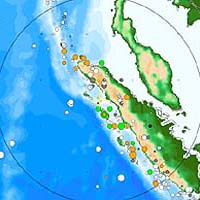
Boulder CO (SPX) Mar 28, 2006 The risks of Sumatra-style megaquakes around the world have been sorely misjudged, say earth scientists who are re-examining some of the pre-December 2004 assumptions scientists made about such rare events. For more than two decades geologists had thought that the largest quakes, of magnitude 9 and greater, happen when a young tectonic plate is subducted, or shoved quickly, under another plate. But the Great Sumatra-Andaman earthquake of 26 December 2004 didn't match that pattern at all. The Indian Plate is middle-aged and moving at a middling rate, which throws into question the estimated quake dangers at other similar quake-prone zones near Japan, in the Pacific Northwest, Chile, Alaska, and elsewhere. "We didn't expect such a big earthquake in that location," said Emile Okal of Northwestern University. Okal is slated to speak about how the Sumatra-Andaman quake calls into question theoretical assumptions made about other similar dangers zones worldwide and especially in South America on Thursday, 6 April, at Backbone of the Americas - Patagonia to Alaska. The meeting is co-convened by the Geological Society of America and Asociaci�n Geol�gica Argentina, with collaboration of the Sociedad Geol�gica de Chile. The meeting takes place 3-7 April in Mendoza, Argentina. Previous to the catastrophic 26 December 2004 earthquake, the theory about how subduction zones generate quakes was straightforward, says Okal. It boiled down to age and speed. Where an older, colder and therefore denser slab of crust is being pushed slowly under another plate, "It will want to sink," he said. As a result there's not a lot of stress building up to cause large quakes. At the other end of that same spectrum are subduction zones where young, buoyant crust is being forced quickly under another plate. The rate of "convergence" and the fact that the young crust resists sinking causes lots of stress to build up and results in much larger quakes. "So you could take a map of all the subduction zones of the world and look at it," said Okal. "The red areas were ones with younger, faster moving crust and the blue areas were older, slow moving crust." The theory seemed tidy enough and could be verified somewhat by dating the crust, measuring the rates entire tectonic plates seemed to be moving at, and estimating the power of past quakes from historical accounts. According to the theory, the Sumatra subduction zone was capable of no more than a magnitude 8 earthquake, Okal explains. "The cold shower we got was Sumatra," said Okal. "We have a 9.3 on our hands. You got a point that violates the plan outrageously." Fortunately, says Okal, the science of plate tectonics has made great strides since the 1980s and the danger map now can be greatly refined and reassessed. For instance, where once researchers looked to the centers of plates to see how fast they may be colliding at the edges, Global Positioning System technology now allows geophysicists to track specific movements and deformation in the actual subduction zone. The result is that some places may be at greater risk of large quakes, and others may be at lesser risk. "Suddenly there are points moving up and down when you reassess them," he said. It's been discovered, for instance, that despite being one of the best big-quake factories on the planet, the convergence of the Nazca Plate and the South American Plate on the Pacific Coast of South America is happening at a significantly slower rate than previously thought, says Okal. On the other hand, some subduction zones have quakes that do not directly express the subduction - and so have inflated the apparent risk of a large event. One example is in the Caribbean where, besides a subduction zone, there are quakes that occur along strike-slip, San Andreas-type, faults. These faults accommodate sideways movement in the collision zone instead of the blunt shoving of one plate under another. "So we are reassessing this whole area," said Okal. There is also the matter of how subduction zones let loose their built-up energy. They can break along small segments, together or individually. One segment might produce a moderate quake. But if four or five segments all go at once you get a colossal release of seismic energy, like that seen when the Sumatra-Andaman zone "unzipped" for 800 miles (nearly 1,300 kilometers) on that terrible day 15 months ago. "The bottom line is that we have to be very humble," said Okal. We don't know how to predict the size of quakes, he said, and we should not discount that there will be surprises. Related Links Geological Society of America Asociaci�n Geol�gica Argentina Sociedad Geol�gica de Chile Backbone of the Americas � Patagonia to Alaska  Singapore Completes First Phase Of Tsunami Early Warning System
 Singapore (AFP) Mar 24, 2006
The first phase of a tsunami early warning system allowing Singapore to exchange real-time earthquake data with networks in Malaysia, Indonesia and Australia has been completed, the city-state said Thursday. |
|
|

| The content herein, unless otherwise known to be public domain, are Copyright 1995-2006 - SpaceDaily.AFP and UPI Wire Stories are copyright Agence France-Presse and United Press International. ESA PortalReports are copyright European Space Agency. All NASA sourced material is public domain. Additionalcopyrights may apply in whole or part to other bona fide parties. Advertising does not imply endorsement,agreement or approval of any opinions, statements or information provided by SpaceDaily on any Web page published or hosted by SpaceDaily. Privacy Statement |