|
 |
 |
 |
 |
 |
 |
 |
 |
 |

| . |  |
. |
Western Prairies Face Impending Water Crisis
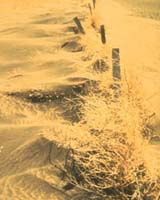
Edmonton, Canada (SPX) Apr 05, 2006 The Canadian prairies are facing an unprecedented water crisis due to a combination of climate warming, increase in human activity and historic drought, says new research by the University of Alberta's Dr. David Schindler, one of the world's leading environmental scientists. "The western prairies are worse than other areas of Canada," said Schindler, co-author of a paper published in the journal "Proceedings of National Academy of Sciences," early online edition. "One of the referees on this paper said, 'wow, this is like looking out the window of a locomotive 10 seconds before the train crashes.' It is a very dire situation". Although most global studies rank Canada among the top five countries in terms of per-capita water supply, those rankings can be deceptive, argue Schindler and Dr. Bill Donahue, who co-authored the paper. Canada's western prairie provinces (WPP), for example, have an area of 2 million kms that lie in the rain shadow of the Rocky Mountains and as a result, are the driest large area of southern Canada. Little research has been done on the cumulative effects of climate warming, drought and human activity on water shortages. Schindler and Donahue found that the biggest threat was a combined one, made up of several ingredients. First, there is now considerable evidence that the 20th century, when settlers arrived, was the wettest century for at least a couple of millenia. What we think of as normal was not normal in the long-term. "Most earlier centuries had one or more prolonged droughts, some of 10-40 years," said Schindler. "So we should probably not expect a second wet century in a row." Climate warming is a second factor that will exacerbate any droughts. This new research shows that there is already a decline in glaciers that supply water to our rivers, snowpacks are dwindling and there is higher precipitation evaporation. The western prairies have already warmed by two to four degrees and this is expected to double by mid-century, the researchers argue in the paper. Our rapidly growing population also means we are using more water for industry and agriculture, both of which are increasing as well. Some rivers--the Bow and Oldman in southern Alberta--are already oversubscribed, says Schindler. Making it worse, we are destroying the features of our watersheds that protect these rivers, he said. "We drain or fill wetlands and destroy our riparian forests--all of the features that could help our landscape to retain the water it does get." One reason this dismal situation has been underestimated is that previous analyses have considered total annual flow, which has declined only slightly for most rivers. Schindler and Donahue looked at summer--May to August--flows. This is the period when human demand is at the highest for irrigation, agriculture and municipalities and when coldwater fisheries are vulnerable to high temperature and low oxygen. Although reducing greenhouse emissions would have the greatest effects several decades from now, it would have little short-term impact, says Schindler. "We cannot replace the glaciers so our only alternative is to get very serious about water conservation and protection of the watersheds that supply our water," he said. For example, it is imperative to use less water for agriculture through drought resistant crops or incentives for water conservation and to consider reusing water and low-flow devices as ways to conserve our supply. We should also consider if and where we want population and industry to increase, said Schindler. "As we show, the less water available to dilute pollutants, the more water quality problems we will see," said Schindler, adding parts of the southwest United States are currently experience water crises for the same reasons. "I don't think we want to face the same problems Los Angeles or Phoenix has, but they will come unless we start protecting our water." Related Links University of Alberta  Ocean Acidification Threatens Cold-Water Coral Ecosystems
 Bellevue WA (SPX) Apr 04, 2006
Corals don't only occur in warm, sun-drenched, tropical seas; some species are found at depths of three miles or more in cold, dark waters throughout the world's oceans. Some cold-water coral reefs are home to more than 1,300 species of animals, a diversity rivaling some better known tropical coral reefs. |
|
|

| The content herein, unless otherwise known to be public domain, are Copyright 1995-2006 - SpaceDaily.AFP and UPI Wire Stories are copyright Agence France-Presse and United Press International. ESA PortalReports are copyright European Space Agency. All NASA sourced material is public domain. Additionalcopyrights may apply in whole or part to other bona fide parties. Advertising does not imply endorsement,agreement or approval of any opinions, statements or information provided by SpaceDaily on any Web page published or hosted by SpaceDaily. Privacy Statement |