
WATER WORLD
Asian aerosols linked to slowing Atlantic Ocean currents
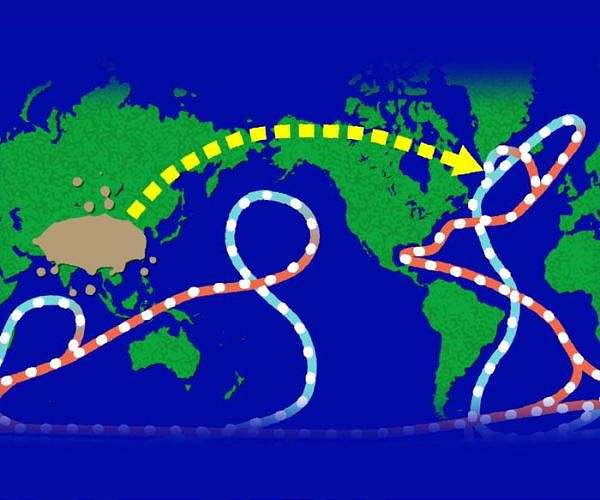
One parcel of water will take about 1,000 years to travel the full length of the AMOC.
Asian aerosols linked to slowing Atlantic Ocean currents
by Clarence Oxford
Los Angeles CA (SPX) Mar 19, 2024
The Atlantic Meridional Overturning Circulation (AMOC), a vital component of the Earth's climate system, has attracted significant scientific and public interest since its monitoring began in 2004. It has inspired extensive research and even became the backdrop for a highly successful movie.

Recent findings, published in Nature Communications, shed light on how aerosols from Asia influence the AMOC. The study, "Increased Asian Aerosols Drive a Slowdown of Atlantic Meridional Overturning Circulation," highlights the significant impact of these particles on the circulation's pace.

Jian Lu, an Earth scientist from the Pacific Northwest National Laboratory (PNNL), collaborated with colleagues from the Ocean University of China and the Max Planck Institute for Meteorology to explore the complex interactions between aerosols and the AMOC. Their research marks a pivotal step in understanding the AMOC's response to external factors.

The AMOC, often likened to a global conveyor belt, plays a critical role in distributing heat and nutrients across the Atlantic. This process affects climate conditions on adjacent continents. Lu compares the AMOC to a household ventilation system, emphasizing the potential climate ramifications if this "conveyor belt" were to slow down or cease.

This new study focuses on the impact of anthropogenic, or human-made, aerosols, particularly from Asia. While previous research has acknowledged the role of greenhouse gases and aerosols from North America and Europe in the AMOC's deceleration, the effects of Asian aerosols remained less understood.

Through advanced climate model simulations, the team demonstrated how increased aerosol emissions from Asia cool the Earth's surface and subsequently slow the AMOC. This discovery underlines the interconnectedness of global climate systems and the far-reaching effects of regional pollution.

The research underscores the importance of reducing emissions from anthropogenic aerosols in Asia. Such measures could mitigate local pollution levels and contribute to stabilizing the AMOC, with broader implications for global climate stability.

Lu's involvement in the study was supported by the DOE Office of Science's Biological and Environmental Research program, highlighting the significance of international collaboration in addressing global environmental challenges.

Research Report:Increased Asian aerosols drive a slowdown of Atlantic Meridional Overturning Circulation

Related Links
Pacific Northwest National Laboratory
Water News - Science, Technology and Politics

Tweet

WATER WORLD
Darwin's Galapagos island species, protected yet still at risk
Puerto Ayora, Ecuador (AFP) Mar 16, 2024
Industrial fishing boats hover menacingly on the edges of Ecuador's Galapagos Marine Reserve, where schools of multicolored fish and hammerhead sharks frolic in the protected Pacific waters. The reserve is a haven for the flurry of creatures and plants living in the waters around the Galapagos Islands where naturalist Charles Darwin found the inspiration for his theory of natural selection. But outside its boundaries, not delineated by any physical barrier, there is no protection on the high se ... read more

WATER WORLD
Rafah displaced shiver as thunder and rain lash tent camp

Syria's Al-Hol camp: child inmates and false identities

'Open Arms' charity vessel carrying 200 tons of food arrives on Gaza coast

Germany can't sit by and watch Gaza starve, Scholz tells Netanyahu

WATER WORLD
UC San Diego Scientists Unveil Plant-Based Polymers that Biodegrade Microplastics in Months

Frost-resistant concrete technology from Drexel could make salt and shovels obsolete

Kobe breakthrough offers blueprint for enhanced photon up-conversion materials

Using nature's recipe for 3D-printed wood

WATER WORLD
Nauru president to visit China after cutting ties with Taiwan

Philippine Coast Guard accuses Chinese vessel of trying to block scientists

El Nino's Role in the Accelerated Global Sea Level Rise of 2023

Russian strikes badly damage Ukraine's largest hydro plant

WATER WORLD
Mapping the Future: SEA-Quester's Role in Blue Carbon Strategy

Indigenous Colombians fret as sacred mountain glaciers melt

Indigenous Colombians fret as sacred mountain glaciers melt

NATO prepares for Russian threat in harsh Arctic

WATER WORLD
In Spain, hi-tech hops keep beer bitter as climate bites

Zimbabwean farmers buckle under El Nino drought

EU chief outlines more concessions for bloc's farmers

UN disputes attack over meat-eating 'omission' in climate plan

WATER WORLD
Magnitude 6.9 quake hits Papua New Guinea: USGS

Tokyo rattled by quake, no tsunami warning

Southeast Brazil battered by downpours, over a dozen killed

Volcanic eruptions over 2000 years and global cooling events

WATER WORLD
Nigerian troops rescue 16 kidnapped students: army

Uganda's President Museveni promotes son to military chief

Muhoozi Kainerugaba: Uganda's mercurial heir apparent

Nigerian army denies reprisal attacks after soldiers killed

WATER WORLD
No 'human era' in Earth's geological history, scientists say

Enhancing AI Truth Detection: A New Approach Against Economic Deceit

How the brain coordinates speaking and breathing

Becoming human: An ancient genome perspective