
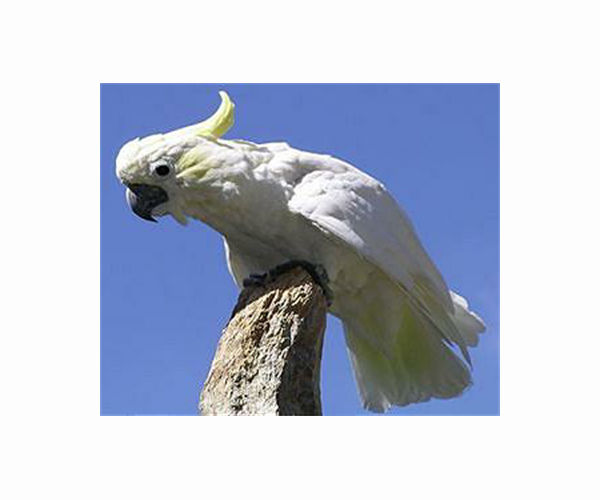
Australia's crafty, sulphur-crested cockatoos appear to have entered an "innovation arms race" with humans, scientists say, as the two species spar over the rubbish in roadside bins.
The white birds, which can grow nearly as long as a human arm, initially surprised researchers by devising an ingenious technique to prise open household bin lids in Sydney and other areas.
Now, a new study says they have gone a step further by thwarting the escalating defences of fed-up humans.
The birds' and humans' behaviour may reveal a hitherto unexplored "interspecies innovation arms race", said a study published Monday in Current Biology.
Nestled between a forest and a surf-swept beach and bordered by cliffs, the picturesque town of Stanwell Park near Sydney is on the front line of the battle of the bins.
"If we don't close the bin right after throwing out the rubbish they'll be in there," said Ana Culic, 21, manager of the town's Loaf Cafe.
"Cockatoos everywhere. Like, just rubbish all over the front area."
Her own family had tried scaring cockatoos away with owl statues to no avail. Then they tried placing bricks on the bin lids, but the cockatoos learned to remove them. Finally, they drilled a lock into the bin.
"They're evolving. Yeah, like if you go back like five-ten years ago, they didn't know how to open bins so they're figuring stuff out," said the cafe's chef, 42-year-old Matt Hoddo.
– Flipping the lid –
Nearby, 40-year-old resident Skie Jones said he had resorted to an elastic cord to hold down the lid of his household bin after the birds worked out how to remove a brick and then a larger rock.
"I have got a feeling I am going to be going for an actual lock," he said. "That's only a matter of time."
Frequent sightings reveal that a single cockatoo can open a bin by holding the lid aloft with its beak while standing near the front edge.
Then, with the bin lid still in its beak, it shuffles backward toward the hinge, forcing the lid ever higher until it flips open.
The scientists found in an earlier study that knowledge of this technique spread as other birds looked on, creating local "traditions".
Their new research shows that humans, frustrated at having their garbage spread across the street, learned to adapt. But then so did the cockatoos.
"When we first started looking at this behaviour, we were already amazed because actually the cockatoos learned how to open the bins," said the study's lead author Barbara Klump, a behavioural scientist at the Max Plank Institute in Germany.
As humans responded, though, "I was really astonished by how many different methods people have invented," she said.
As the cockatoos learned to defeat some of the humans' protections, the two species appeared to be engaged in a "stepwise progression and reiteration", said the postdoctoral research fellow.
"That was the most interesting part for me."
In a census of 3,283 bins, the latest study found that some cockatoos could defeat low-level protections such as rubber snakes, which could be ignored, or bricks, which could be pushed off.
So far, though, the cockatoos had not managed to overcome stronger methods such as a weight actually attached to the lid or an object stuck into the hinge to prevent the bin fully opening.
"Bricks seemed to work for a while but cockies got too clever," one resident told the researchers in an online survey that attracted more than 1,000 participants.
– 'Rats of the sky' –
Who is winning the arms race?
"I think ultimately it will be the humans," said Klump.
"But we need to see how it develops," she added, explaining that it was easy to underestimate the work involved for humans in protecting their bins every week, with some people already relaxing their guard when cockatoo activity decreased.
The interspecies bin struggle is unlikely to lead to a new breed of even cleverer cockatoo, however.
"They have a certain capacity to problem solve, and we know they are super curious and they like to explore," Klump said. "But I don't think that protecting the bins will in itself then make the cockatoos smarter."
Despite the annoyance, many residents in Stanwell Park say they have a soft spot for the birds.
"We call them the rats of the sky because they just love food," said Katherine Erskine, 48, owner of the town's Uluwatu Blue cafe.
"They are beautiful and they're really noisy — but I do love them."
