
SHAKE AND BLOW
Coconuts could inspire new designs for earth-quake proof buildings
by Staff Writers
Washington DC (SPX) Jul 07, 2016


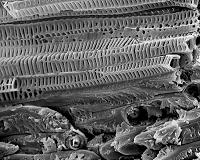
The distinct ladder-like design and angle of the vessels in coconut shells helps to dissipate energy. Image courtesy Plant Biomechanics Group Freiburg. For a larger version of this image please go here.

Coconuts are renowned for their hard shells, which are vital to ensure their seeds successfully germinate. But the specialised structure of coconut walls could help to design buildings that can withstand earthquakes and other natural disasters.

Coconut palms can grow 30 m high, meaning that when the ripe fruits fall to the ground their walls have to withstand the impact to stop them from splitting open. To protect the internal seed, the coconut has a complex structure of three layers: the outer brown, leathery exocarp, a fibrous mesocarp and a tough inner endocarp surrounding the pulp which contains the developing seedling.

As part of a larger project on "Biological Design and Integrative Structures", researchers at the Plant Biomechanics Group of the University of Freiburg have been working with civil engineers and material scientists to investigate how this specialised structure could be applied in architecture.

The researchers used compression machines and an impact pendulum to investigate how coconuts disperse energy.

"By analysing the fracture behaviour of the samples and combining this with knowledge about the shell's anatomy gained from microscopy and computed tomography, we aimed to identify mechanically relevant structures for energy absorption" says plant biomechanist Stefanie Schmier.

Their investigations found that within the endocarp layer - which consists mainly of highly lignified stone cells- the vessels that make up the vascular system have a distinct, ladder-like design, which is thought to help withstand bending forces. Each cell is surrounded by several lignified rings, joined together by parallel bridges.

"The endocarp seems to dissipate energy via crack deflection" says Stefanie. "This means that any newly developed cracks created by the impact don't run directly through the hard shell". It is thought that the angle of the vascular bundles helps to "divert" the trajectory of the cracks. The longer a crack has to travel within the endocarp, the more likely it is that it will stop before it reaches the other side.

The distinct angle of the vascular bundles in the endocarp could be applied to the arrangement of textile fibres within functionally graded concrete, to enable crack deflection. "This combination of lightweight structuring with high energy dissipation capacity is of increasing interest to protect buildings against earthquakes, rock fall and other natural or manmade hazards" says Stefanie.

.


Related Links
Society for Experimental Biology
Bringing Order To A World Of Disasters
When the Earth Quakes
A world of storm and tempest


Comment on this article via your Facebook, Yahoo, AOL, Hotmail login.

Share this article via these popular social media networks
del.icio.usdel.icio.us DiggDigg RedditReddit GoogleGoogle

Previous Report
SHAKE AND BLOW
Indonesian earthquake causes injuries, damages buildings
Padang, Indonesia (AFP) June 2, 2016
A powerful earthquake off Indonesia's Sumatra island on Thursday sent panicked people fleeing for higher ground and left eight people injured and scores of buildings damaged. The 6.5-magnitude quake hit around dawn, waking up residents of the major port city Padang on Sumatra's west coast and sending them running from their homes. No tsunami warning was issued after the tremor, which str ... read more


SHAKE AND BLOW
Nepal selling rice donated for quake victims

Pacific Ocean radiation back near normal after Fukushima: study

Tears, smoke and loss at site of deadly Baghdad blast

Police raids as tensions mount in Italy's Chinatown

SHAKE AND BLOW
New mid-infrared laser system could detect atmospheric chemicals

Winning Students Selected for Future Engineers Star Trek Replicator Challenge

Theoretical climbing rope could brake falls

How water gets its exceptional properties

SHAKE AND BLOW
Ocean circulation implicated in past abrupt climate changes

Seaweeds get sick too when they're stressed

Researchers identify human fingerprint on Indo-Pacific warm pool growth

New technology could improve use of small-scale hydropower in developing nations

SHAKE AND BLOW
Vegetation in Russian Arctic has memory

Expanding Antarctic sea ice linked to natural variability

King penguins keep an ear out for predators

Super-slow circulation allowed world's oceans to store huge amounts of carbon during last ice age

SHAKE AND BLOW
Feeding the world by rewiring plant mouths

Zimbabwe farmers benefit from China agricultural technology transfer

Characteristics improving bean resistance to drought identified

Decoding the genome of the olive tree

SHAKE AND BLOW
Erupting volcano in South Atlantic putting penguin colonies at risk

Taiwan braces for Super Typhoon Nepartak

Coconuts could inspire new designs for earth-quake proof buildings

Indonesian volcano puts on spectacular blue light show

SHAKE AND BLOW
Rwanda hikes import duties on secondhand clothes

Nigeria's ex-air force chief charged with money laundering

Why are UN forces returning control of security to Liberia?

Seven Niger gendarmes killed in refugee camp attack

SHAKE AND BLOW
The history of human genetic ancestry in Madagascar

Ancient Brazilians occupied the same houses for centuries

New study highlights neuronal dynamism in adult brain

Ancient 'Deep Skull' from Borneo full of surprises