
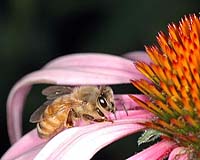
 A queen bumble bee (Bombus bifarius) collects nectar from a flower of the glacier lily (Erythronium grandiflorum) at a research site in Irwin, Colorado. (Photo: David Inouye.) |
"Bee numbers may have declined at our research site, but we suspect that a climate-driven mismatch between the times when flowers open and when bees emerge from hibernation is a more important factor," says James Thomson, a scientist with U of T's Department of Ecology and Evolutionary Biology.
Thomson's 17-year examination of the wild lily in the Rocky Mountains of Colorado is one of the longest-term studies of pollination ever done. It reveals a progressive decline in pollination over the years, with particularly noteworthy pollination deficits early in the season. The study will be published in Philosophical Transactions of the Royal Society B: Biological Sciences on September 6.
Three times each year, Thomson compared the fruiting rate of unmanipulated flowers to that of flowers that are supplementally pollinated by hand.
"Early in the year, when bumble bee queens are still hibernating, the fruiting rates are especially low," he says. "This is sobering because it suggests that pollination is vulnerable even in a relatively pristine environment that is free of pesticides and human disturbance but still subject to climate change."
Thomson began his long-term studies in the late 1980s after purchasing a remote plot of land and building a log cabin in the middle of a meadow full of glacier lilies. His work has been supported by the U.S. National Science Foundation and the Natural Sciences and Engineering Research Council of Canada.
 del.icio.us del.icio.us |
 Digg Digg |
 Reddit Reddit |
 YahooMyWeb YahooMyWeb |
 Google Google |
 Facebook Facebook |

 Artificial Bee Eye Gives Insight Into Insects' Visual World
| The content herein, unless otherwise known to be public domain, are Copyright 1995-2010 - SpaceDaily. AFP and UPI Wire Stories are copyright Agence France-Presse and United Press International. ESA Portal Reports are copyright European Space Agency. All NASA sourced material is public domain. Additional copyrights may apply in whole or part to other bona fide parties. Advertising does not imply endorsement,agreement or approval of any opinions, statements or information provided by SpaceDaily on any Web page published or hosted by SpaceDaily. Privacy Statement |


