|
 |
 |
 |
 |
 |
 |
 |
 |
 |

| . |  |
. |
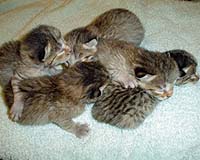
In Breakthrough, Cloned Wildcats Prove Ability To Reproduce
Washington (AFP) Aug 22, 2005 And then there were eight... In a potential breakthrough for bioengineering, three cloned African wildcats living in the United States have produced two healthy litters of kittens, demonstrating for the first time that clones of wild animals can breed. The successful experiment, unveiled by the Audubon Center for Research of Endangered Species in New Orleans, Louisiana, over the weekend, appeared to open the way to bringing severely endangered species back from the brink of extinction, scientists said. But it also raised the question if "Jurassic Park", a fictional nature preserve teeming with cloned dinosaurs and velociraptors invented by novelist Michael Crichton and popularized in a blockbuster 1993 movie, was getting closer to becoming a reality. "The science which produced these beautiful kittens is nothing short of wondrous," commented Ron Forman, president of the Audubon Nature Institute. "We are thrilled to play a part in a scientific journey holding such enormous potential for the worlds animals." The frisky eight, who sport light brown fur, stripes on the back, perked-up ears, and innocent green-blue eyes, were produced by a feline menage a trois that included Ditteaux, the prolific father, and his two female mates - Madge and Caty. The threesome are all clones, who owe their very existence to transfers of frozen embryos taken from two other African wildcats to a domestic cat. Madge gave birth to the first five kittens on July 26 while Caty delivered three others on August 2, according to the center. Both litters are said to be doing well. Scientists said the newly-born kittens will be shown to the public at Audubon Zoo in New Orleans later on this year. But they will be returned to the research center for more study as they grow up and start displaying their mature wildcat instincts. If the wildcats do not develop health problems, the experiment will open new breathtaking opportunities, argue the researchers. "By improving the cloning process and then encouraging cloned animals to breed and make babies, we can revive the genes of individuals who might not be reproductively viable otherwise, and we can save genes from animals in the wild," Doctor Betsy Dresser, director of the center, told reporters. She went on to explain that skin samples of long-dead but genetically valuable animals, if properly frozen, can be cloned to create their genetic match. Those clones species, said Dr Dresser, can then be introduced back into the population through natural breeding. Is Tyrannosaurus Rex somewhere in the pipeline? Not, if official statements are to be believed. According to scientists, in addition to a variety of cats, they are working on the endangered bongo antelope, clouded leopard and several types of the African stork. Related Links SpaceDaily Search SpaceDaily Subscribe To SpaceDaily Express  Two New DNA Sequencing Methods Unveiled
 Boston (UPI) Aug 9, 2005
Two newly developed methods of decoding DNA are expected to be substantially quicker and cheaper than the existing method. |
|
|

| The content herein, unless otherwise known to be public domain, are Copyright 1995-2006 - SpaceDaily.AFP and UPI Wire Stories are copyright Agence France-Presse and United Press International. ESA PortalReports are copyright European Space Agency. All NASA sourced material is public domain. Additionalcopyrights may apply in whole or part to other bona fide parties. Advertising does not imply endorsement,agreement or approval of any opinions, statements or information provided by SpaceDaily on any Web page published or hosted by SpaceDaily. Privacy Statement |