
Some of the most popular crops on the planet rely on agricultural irrigation, a practice shrinking water resources across the globe.
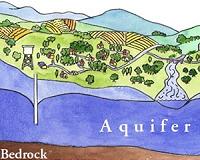
According to new analysis by researchers at NASA, irrigation for a handful of internationally traded crops accounts for 11 percent of non-renewable groundwater withdrawals — that is the water drawn from underground aquifers and won't be replenished on human time-scales.
Scientists looked at the trade patterns of 26 specific crop classes and measured their reliance on non-renewable groundwater. Nearly two-thirds of aquifer-dependent crops are produced in Pakistan, the United States and India. The United States is also one of the biggest importers of aquifer-dependent crops, mostly different varieties than those the U.S. exports.
The latest study — published in the journal Nature — is one of the first to compare non-renewable water usage with a crop's final destination.
"Say I'm in Japan, and I'm importing corn from the United States," Michael Puma, a researcher at NASA's Goddard Institute for Space Studies and Columbia University, said in a news release. "It's important from Japan's perspective to know whether that corn is being produced with a sustainable source of water, because you can imagine in the long term if groundwater declines too much, the United States will have difficulty producing that crop."
NASA's Grace satellites measure groundwater depletion by observing subtle changes in Earth's gravity. The data shows aquifers have steadily diminished across the globe in recent decades.
Roughly 82 percent of all crops are consumed domestically, but research suggests the 18 percent being traded internationally is increasingly comprised of crops reliant on unsustainable groundwater usage.
Understanding the trade and growth patterns of popular water-intensive crops can help policy officials predict how agricultural trends will affect water resources.
"What's innovative about this study is it connects groundwater depletion estimates with country level data," said NASA scientist and hydrologist Matt Rodell.
Rodell hopes follow-up research will address other factors affecting non-renewable water resources like population growth, changing diets and climate change.
Fog and dew keep Africa's Namib Desert ecosystem going
The ocean is not the sole source of the fog that sustains life for numerous plants and animals living in Africa's coastal Namib Desert. The fog also comes from groundwater and other sources, report ecohydrologists supported by the National Science Foundation (NSF) and affiliated with Indiana University-Purdue University Indianapolis (IUPUI).
The scientists conducted the research in one of … read more
