|
 |
 |
 |
 |
 |
 |
 |
 |
 |

| . |  |
. |
NASA Satellite Sees Solar Hurricane Tear Comet Tail Off
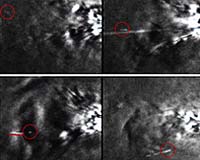
Washington DC (SPX) Oct 02, 2007 NASA's STEREO satellite captured the first images ever of a collision between a solar "hurricane", called a coronal mass ejection (CME), and a comet. The collision caused the complete detachment of the comet's plasma tail. Comets are icy leftovers from the solar system's formation billions of years ago. They usually hang out in the cold, distant regions of the solar system, but occasionally a gravitational tug from a planet, another comet, or even a nearby star sends them into the inner solar system. Once there, the sun's heat and radiation vaporizes gas and dust from the comet, forming its tail. Comets typically have two tails, one made of dust and a fainter one made of electrically conducting gas, called plasma. CMEs are large clouds of magnetized gas ejected into space by the sun. They are violent eruptions with masses upwards of a few billion tons traveling anywhere from 100 to 3,000 kilometers per second (62 to 1,864 miles/second). They have been compared to hurricanes because of the widespread disruption they can bring when directed at Earth; CMEs are known to cause geomagnetic storms that can present hazards for satellites, radio communications, and power systems. Comet Encke was traveling within the orbit of Mercury when a CME scrunched the tail and eventually tore it off the comet. Scientists at the Naval Research Laboratory (NRL) made the observations using the Heliospheric Imager (HI) in NRL's Sun Earth Connection Coronal and Heliospheric Investigation (SECCHI) telescope suite aboard NASA's Solar Terrestrial Relations Observatory (STEREO)-A spacecraft. Scientists have been aware of this spectacular phenomenon, the disconnection of the entire plasma tail of a comet, for some time. However, the conditions that lead to these events remained a mystery. Scientists suspected that CMEs could be responsible for some of the disconnection events, but the interaction between a CME and a comet had never been directly observed. Because the HI instrument can take many images rapidly, and the images are very detailed, scientists were able to obtain a series of images of the comet and tail disconnection as the event occurred. The researchers combined the images into a movie. This never-before-seen movie was recorded on April 20, 2007, when a CME encountered comet Encke. The observations reveal the brightening of the comet tail as the CME swept by and its subsequent disconnection and transport by the CME front. A preliminary analysis suggests that the tail was ripped away when magnetic fields bumped together in an explosive process called "magnetic reconnection." Oppositely directed magnetic fields around the comet "bumped into each" by the magnetic fields in the CME. Suddenly, these fields linked together--they "reconnected"--releasing a burst of energy that rent the comet's tail. A similar process takes place in Earth's magnetosphere during geomagnetic storms fueling, among other things, the Northern Lights. "The comet had its own space weather event," said Angelos Vourlidas, Lead author and Researcher with the Naval Research Laboratory, Washington, DC. "We think it experienced a magnetic reconnection event very similar to what Earth experiences when CMEs impact our own protective magnetosphere." Community Email This Article Comment On This Article Related Links STEREO Solar Science News at SpaceDaily
 Solar Experts Gathering At ORNL For Summit
 Oak Ridge TN (SPX) Sep 21, 2007
Solar energy will be in the spotlight as researchers, engineers, architects and other renewable energy experts from the region convene at Oak Ridge National Laboratory Oct. 24-25 for the first Southeast Solar Summit. Among the displays will be an Arizona Public Service 5-kilowatt photovoltaic solar array that will be providing electricity to one of the laboratory buildings. The array uses Memphis-based Sharp Solar's photovoltaic modules. |
|
|

| The content herein, unless otherwise known to be public domain, are Copyright 1995-2007 - SpaceDaily.AFP and UPI Wire Stories are copyright Agence France-Presse and United Press International. ESA Portal Reports are copyright European Space Agency. All NASA sourced material is public domain. Additional copyrights may apply in whole or part to other bona fide parties. Advertising does not imply endorsement,agreement or approval of any opinions, statements or information provided by SpaceDaily on any Web page published or hosted by SpaceDaily. Privacy Statement |