
DISASTER MANAGEMENT
Risk aversion helps ants avoid obstacles, predators
by Brooks Hays
Washington DC (UPI) Apr 09, 2020

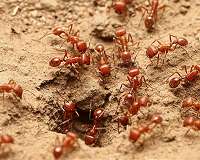
Ants are adept navigators, but when ants find their typical route blocked by an obstacle or predator, they're able to adjust, according to a new study.

But ants don't simply ad-lib a workaround. Research suggests they adopt and memorize a new preferred path.

Lab tests showed ants use what scientists dubbed an aversive learning mechanism. By associating visual cues with negative experiences, ants can memorize and avoid dangerous routes.

For the tests, scientists at the French National Center for Scientific Research placed a pit trap with slippery walls in the ants' path back to the nest. A tiny bridge disguised by twigs allowed the trapped ants to escape.

At first, all of the ants bee-lined right into the trap on their way home. On the second go-around, many of the ants slowed and even stopped. The cautious ants scanned the environment and opted for an alternate route.

The tests -- described in the journal Current Biology -- showed ants recalled the visual stimuli that preceded their sudden fall and later recalled those cues.

Researchers tested two species of desert ant, Melophorus bagoti from Australia and Cataglyphis fortis from the Sahara, and observed similar results.

"The views experienced before falling into the trap become associated with the ensuing negative outcome and thus trigger salutary turns on the subsequent trip," scientists wrote in their paper. "This drives the ants to orient away from the goal direction and avoid the trap. If the pit trap is avoided, the novel views experienced during the detour become positively reinforced and the new route crystallizes."

Scientists plan to incorporate the newly identified aversive learning mechanism into their current neural models to better understand the intricacies of the insect nervous system.


Related Links
Bringing Order To A World Of Disasters
A world of storm and tempest
When the Earth Quakes

DISASTER MANAGEMENT
In Asia, bucking the global lockdown trend
Hong Kong (AFP) April 8, 2020
As the coronavirus pandemic sparks global lockdowns, life has continued comparatively unhindered in places like Taiwan, South Korea and Hong Kong after their governments and citizens took decisive early action against the unfolding crisis. At first glance Taiwan looks like an ideal candidate for the coronavirus. The island of 23 million lies just 180 kilometres (110 miles) off mainland China. Yet nearly 100 days in, Taiwan has just 376 confirmed cases and five fatalities while restaurants, bars, ... read more

Comment using your Disqus, Facebook, Google or Twitter login.

Share this article via these popular social media networks
del.icio.usdel.icio.us DiggDigg RedditReddit GoogleGoogle

DISASTER MANAGEMENT
Army awards $10B in contracts for COVID-19 care facility construction

Is this the end of civilisation as we know it?

Ukraine denies radioactive spike from Chernobyl forest fire

In Asia, bucking the global lockdown trend

DISASTER MANAGEMENT
Virus lockdown boosts South African virtual safari tours

Scientists in Japan develop decomposable plastic

A milestone in ultrafast gel fabrication

On-demand glass is right around the corner

DISASTER MANAGEMENT
Biodiversity hotspots could become first generation of high seas marine protected areas

Climate change triggers Great Barrier Reef bleaching

Britain's plankton population has changed dramatically over the last 60 years

How old are whale sharks? Nuclear bomb legacy reveals their age

DISASTER MANAGEMENT
The Arctic may influence Eurasian extreme weather events in just two to three weeks

Canada deploys Arctic Rangers to Inuit villages amid pandemic

How horses can save the permafrost

Hidden source of carbon found at the Arctic coast

DISASTER MANAGEMENT
Invasive Asian hornet could cost Europe millions in damages

Kenya bans controversial donkey slaughter trade

DR Congo latest victim of locust swarms: experts

Virus sparks boom for local farmers in import-dependent Hong Kong

DISASTER MANAGEMENT
Pacific's monster storm destroys tourist resorts in Tonga

New NASA radar looks to monitor volcanoes and earthquakes from space

Monster cyclone tears through Vanuatu town

Monster cyclone Harold tears through Fiji

DISASTER MANAGEMENT
Chinese virus medics arrive in Nigeria despite protest

New energy strategy in Cameroon to help avert 28,000 deaths and reduce global temperatures

Gabon bans eating of pangolin and bats amid pandemic

France confirms 4 coronavirus cases in anti-jihadist Africa force

DISASTER MANAGEMENT
The evolution of arthritic knees

Squatting or kneeling may have health benefits

Isolated and afraid: How the pandemic is changing pregnancy

Ancient hominins had small brains like apes, but longer childhoods like humans