
FROTH AND BUBBLE
Satellites and light reflections help spot coastal plastic waste
by Staff Writers
Melbourne, Australia (SPX) Feb 03, 2022

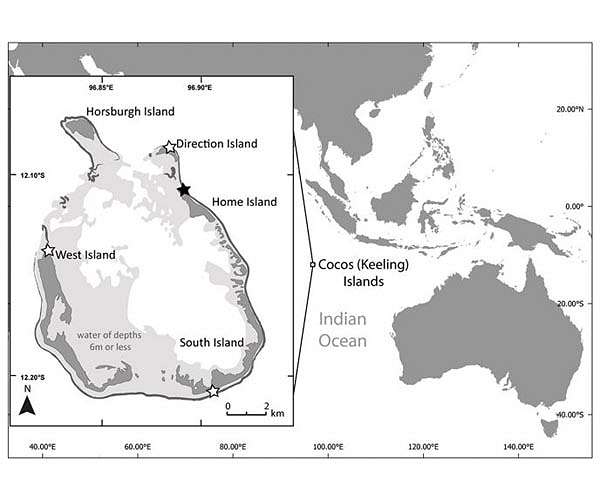
Geospatial scientists have found a way to detect plastic waste on remote beaches that are not visible in conventional satellite images, bringing us closer to global monitoring options. Map showing the Cocos (Keeling) Islands off the west Australian coast.

Millions of tons of plastic enter the oceans every year. While stopping this flow is crucial, so is tracking down what's already there so we can clean it up.

This cutting-edge research harnesses the latest in satellite technology to do just that.

The study, now published in Remote Sensing, used the unique infrared signals reflected by plastics to identify even tiny scraps amongst vast stretches of sand and rocks.

This sets the foundation for allowing plastics to be detected within satellite images where plastics are smaller than a pixel.

Lead author of the study and PhD candidate Jenna Guffogg of RMIT University in Melbourne, Australia said monitoring beaches rather than oceans made sense because it's easier to remove the rubbish.

"Stopping plastic from entering the ocean is a global challenge. But if we can find and remove them quickly, it's the next best thing," she said.

"At the moment, plastic debris are tracked by passing vessels notifying authorities. Using satellites will allow more frequent and reliable observations.

"Our work could let organisations who do remote coastal and marine waste clean-up management know where to focus their efforts."

Guffogg and her team completed fieldwork on the remote beaches of Australia's Cocos (Keeling) Islands, using sensing equipment to capture how infra-red light was reflected by different types of plastic found on the Islands.

To calculate how much plastic washed up on the shore, researchers used spectral library plots to compare plastics' reflectance with its cover.

They compared spectral readings from the weathered plastics with virgin plastics that hadn't been exposed to environmental degradation and found little difference between results.

This means despite the shape, colour or condition of the plastic, there's a good chance it can be detected remotely, and the location shared with clean-up groups.

Other uses could include tracking an area's health, judging by the amount of plastic in the environment.

RMIT Professor of Remote Sensing, Simon Jones, said the study was about looking at ways we can use satellites to see things the human eye can't.

"In the next few years, we're going to launch satellites with even better remote sensing capabilities," he said.

"We're developing ways to use these new satellites in the fight against marine waste."

While the true extent of the Cocos (Keeling) Islands' plastic problem is yet to be revealed, future studies Guffogg and the team are working on aim to answer this.

Research Report: "Quantifying Marine Plastic Debris in a Beach Environment Using Spectral Analysis"


Related Links
RMIT University
Our Polluted World and Cleaning It Up

FROTH AND BUBBLE
Dutch probe Tata Steel for 'intentional' pollution
The Hague (AFP) Feb 2, 2022
Dutch prosecutors opened a criminal probe Wednesday into "intentional and unlawful" pollution by steel giant Tata at a plant near Amsterdam, saying the public's health could potentially be in danger. The massive plant at the mouth of the IJ river has come under increasing fire from residents and health authorities, who accuse it of being the main source of air, soil and water pollution in the area and of causing illness. "The public prosecutor's office has informed Tata Steel... that it has open ... read more

Comment using your Disqus, Facebook, Google or Twitter login.

Share this article via these popular social media networks
del.icio.usdel.icio.us DiggDigg RedditReddit GoogleGoogle

FROTH AND BUBBLE
At least 11 dead in Colombia mudslide

Eruption-hit Tonga closes borders as Covid detected

Extreme weather kills 140,000 Europeans in 40 years: report

Australia says warship did not bring Covid to eruption-hit Tonga

FROTH AND BUBBLE
New lightweight material is stronger than steel

Indian Space Agency decommissions communication satellite

High level of artificial radioactivity on glaciers surprises physicists

Taiwan eases nuclear-accident food import ban from Japan

FROTH AND BUBBLE
NGO files complaint over dead fish deluge off French coast

The abyssal world: the last terra incognita of the Earth surface

Police operation targets illegal water tapping in Spain

Corals doomed even if global climate goals met: study

FROTH AND BUBBLE
NASA Greenland mission completes six years of mapping unknown terrain

Glaciers are melting faster and with more consequences than expected

Mountain glaciers hold less ice than thought, and that's bad news

New atlas finds globe's glaciers have less ice than previously thought

FROTH AND BUBBLE
Monitoring crop health across the Netherlands

Can eliminating meat production save Planet Earth

UK's Kew tribute to Costa Rica at annual orchid fest

Start ups bringing Pakistan's farming into digital age

FROTH AND BUBBLE
Hidden magnitude-8.2 earthquake source of mysterious 2021 global tsunami

Cyclone Batsirai kills 10, displaces nearly 48,000 in Madagascar

Humanitarian crisis feared as cyclone kills 21 in Madagascar

Big data imaging shows rock's big role in channeling earthquakes in Japan

FROTH AND BUBBLE
Guinea interim assembly holds first post-coup session

Livelihoods lost as climate disaster woes mount in Kenya

Mali publishes bill to shore up junta leader's powers

W.African peacekeepers to deploy in Guinea-Bissau after coup bid

FROTH AND BUBBLE
Watch a chimpanzee mother apply an insect to a wound on her son

Where did that sound come from?

First evidence of long-term directionality in the origination of human mutation

12,000-year-old rock art in North America