
SHAKE AND BLOW
Study explains severity of 9.2 magnitude Sumatra earthquake
by Brooks Hays
Washington (UPI) May 25, 2017


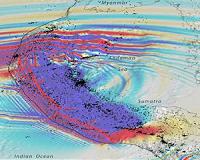
New research suggests ancient Himalayan sediments account for the severity of the 2004 earthquake in Sumatra.

The epicenter of the magnitude 9.2 earthquake occurred just west of Sumatra, Indonesia, in December 2004. It was generated by the subduction of the Indian Plate beneath the Burma Plate and triggered a series of tsunamis that obliterated coastal communities throughout Southeast Asia, killing more than 250,000 people.

In an effort to better understand the dynamics of the devastating quake, researchers analyzed samples collected from deep beneath the floor of the Indian Ocean.

"The 2004 Indian Ocean tsunami was triggered by an unusually strong earthquake with an extensive rupture area," Lisa McNeill, professor of geology at the University of Southampton, said in a news release. "We wanted to find out what caused such a large earthquake and tsunami and what this might mean for other regions with similar geological properties."

McNeill and her research partners found evidence of ancient sediment deposits originating from the Himalayan mountain range and Tibetan Plateau. After analyzing the physical and chemical properties of the sediment layers, researchers built a model to simulate their behavior near a subduction zone.

Researchers found the thick layers of sediments would have become heated to dehydrated as they migrated toward the subduction zone, creating a stronger, more rigid material which encouraged a more violent fault slip.

"Our findings explain the extent of the large rupture area, which was a feature of the 2004 earthquake, and suggest that other subduction zones with thick and hotter sediment and rocks, could also experience this phenomenon," said Andre Hüpers, researcher at the University of Bremen.

The findings -- detailed in the journal Science -- could help researchers more accurately estimate the risks of earthquakes in subduction zones with thick, hot sediment and rock.

SHAKE AND BLOW
From where will the next big earthquake hit the city of Istanbul
Potsdam, Germany (SPX) May 18, 2017
The city of Istanbul is focus of great concern for earthquake researchers. This 15-million metropole is situated very close to the so-called North Anatolian Fault Zone which runs just outside of the city gates below the Marmara Sea. Here in the underground there is a constant build-up of energy which results from an interlocking of the tectonic plates causing plate movement to come to a halt unt ... read more

Related Links
Bringing Order To A World Of Disasters
When the Earth Quakes
A world of storm and tempest

Comment using your Disqus, Facebook, Google or Twitter login.

Share this article via these popular social media networks
del.icio.usdel.icio.us DiggDigg RedditReddit GoogleGoogle

SHAKE AND BLOW
UN braces for up to 200,000 Iraqis to flee Mosul

Why civilian deaths in Iraq and Syria are increasing

Airbus Foundation and Airbus BizLab seek innovative concepts for humanitarian challenges

Witnesses to trauma can develop irrational fears

SHAKE AND BLOW
One-dimensional crystals for low-temperature thermoelectric cooling

New theory predicts wetted area of droplets colliding with flat surface

Physicists discover mechanism behind granular capillary effect

Collecting real-time data for material microstructural evolution during radiation exposure

SHAKE AND BLOW
Researchers untangle causes of differences in East Coast sea level rise

LA lawns use 70 billion gallons of water a year

Great Barrier Reef bleaching worse than first thought

How X-rays helped to solve mystery of floating rocks

SHAKE AND BLOW
Methane seeping from Arctic seabed may have an upside

NASA's Arctic Ecosystem Science Flights Begin

Elevation could help explain why Antarctica is warming slower than Arctic

China says no mining planned in Antarctica

SHAKE AND BLOW
In China, maggots finish plates, and food waste

Bordeaux pins hopes for ravaged vineyards on June bloom

Bordeaux pins hopes for ravaged vineyards on June bloom

Helping plants pump iron

SHAKE AND BLOW
Study explains severity of 9.2 magnitude Sumatra earthquake

Sri Lanka deploys thousands of troops as flood toll climbs to 169

Expect above-average Atlantic hurricane season, US forecasters say

Sri Lanka deploys more troops as flood toll climbs to 180

SHAKE AND BLOW
Biafra's military veterans: no regrets, 50 years on

Africa, so close yet so far from G7 summit

Rwanda to control presidential candidates' social media use

Nigeria seizes illegal arms shipment

SHAKE AND BLOW
New hypothesis about the origin of humankind suggests oldest hominin lived in Europe

Portions of human skeletal structure were established millions of years earlier than previously thought,

Study reveals architecture of the 'second brain,' the enteric nervous system

'Moral enhancement' technologies are neither feasible nor wise