
DISASTER MANAGEMENT
Study finds pedestrians need 30 inches of space to avoid collisions
by Brooks Hays
Washington (UPI) Dec 17, 2018

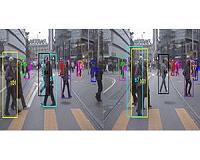
Pedestrians require a 30-inch buffer to avoid collisions, according to a new survey of foot traffic inside a Dutch train station.

Using overheard sensors installed in a train station in Eindhoven, Netherlands, researchers analyzed more than 5 million pedestrian movements. Their analysis revealed 9,000 pedestrian pairs on collision courses.

"About 40 pairs of these actually bumped into each other," Alessandro Corbetta, a postdoctoral researcher at the Eindhoven University of Technology, said in a news release. "The remaining pairs adapted their walkways until they were at least [55 inches] apart and were therefore able to prevent a collision."

Researchers used the video footage to train a computer model to predict the movements of pedestrians moving through a crowded space. The model could help designers better understand how spatial dimensions and the size of crowds impact the ability of pedestrians to avoid collisions.

"To build our model, we found two 'social interaction forces' that play a role: a long-distance force based on vision and a short distance force for preventing hard contacts," Corbetta said. "As an effect of these forces, people modify their current paths to prevent collisions."

Corbetta and his colleagues used their previous survey of pedestrians walking through a corridor, as well as models of fluid dynamics, to design their new simulation.

The new analysis, published this week in the journal Physical Review E, suggests there are universal patterns of pedestrian movements unaffected by the setting and space.

"We saw in our data that about one in 1,000 people would stop and invert their trajectories, to exit the tunnel or corridor from the same side as they entered it," said Federico Toschi, Eindhoven professor. "Even though they were walking alone and regardless of the motivation."

Researchers plan to continue developing more complex models to understand the movements of even denser crowds. Corbetta and Toschi are currently analyzing the results of an experiment designed to test the influence of lights on pedestrian patterns.

"We let pedestrians choose to leave our exhibit through the left or the right exit," Toschi said. "Using light with different intensity levels, we aimed at altering routing decisions in favor of one of the two exits. The first results now indicate that it does indeed appear to be possible to steer people."


Related Links
Bringing Order To A World Of Disasters
A world of storm and tempest
When the Earth Quakes

DISASTER MANAGEMENT
New foldable drone flies through narrow holes in rescue missions
Zurich, Switzerland (SPX) Dec 17, 2018
Inspecting a damaged building after an earthquake or during a fire is exactly the kind of job that human rescuers would like drones to do for them. A flying robot could look for people trapped inside and guide the rescue team towards them. But the drone would often have to enter the building through a crack in a wall, a partially open window, or through bars - something the typical size of a drone does not allow. To solve this problem, researchers from the Robotics and Perception Group at the Univ ... read more

Comment using your Disqus, Facebook, Google or Twitter login.

Share this article via these popular social media networks
del.icio.usdel.icio.us DiggDigg RedditReddit GoogleGoogle

DISASTER MANAGEMENT
New foldable drone flies through narrow holes in rescue missions

The daring China rescues bringing Vietnam's trafficked girls home

Mothers of the Missing: Anguished search for Vietnam's kidnapped brides

'Sold by my brother': the Mekong women pressed into marriage in China

DISASTER MANAGEMENT
The stiffest porous lightweight materials ever

NYU researchers pioneer machine learning to speed chemical discoveries, reduce waste

Gaming firm settles VR lawsuit with Facebook-owned Oculus

Terahertz laser for sensing and imaging outperforms its predecessors

DISASTER MANAGEMENT
Warning over deep-sea 'gold rush'

Research unlocks secrets of iron storage in algae

Cambodia hails opening of country's largest dam despite opposition

A damming trend

DISASTER MANAGEMENT
A new model of ice friction helps scientists understand how glaciers flow

Snow over Antarctica buffered sea level rise during last century

NASA finds Asian glaciers slowed by ice loss

Fighting climate change in the shadow of Mount Everest

DISASTER MANAGEMENT
IS 'annihilation' of Iraqi farms leaves haunting legacy

Red gold: Afghanistan saffron production grows

Egypt's fertile Nile Delta threatened by climate change

German farmers sue government over missed climate targets

DISASTER MANAGEMENT
Severe tropical cyclone bears down on north Australia coast

Floods kill 13 in central Vietnam

Alaska earthquakes offer new insight into improving hazard assessment

Scientists brew lava and blow it up to better understand volcanoes

DISASTER MANAGEMENT
Bolton outlines shift in Africa strategy for military, civilian aid

Ethiopia jails soldiers who protested for better pay

US lashes out at 'predatory' China, Russia in Africa

Russian influence on show in C. African beauty contest

DISASTER MANAGEMENT
Peering into Little Foot's 3.67 million-year-old brain

100 marathons, 100 days: A punishing run for water

Human-altered environments benefit the same cosmopolitan species all over the world

Great apes and ravens plan without thinking