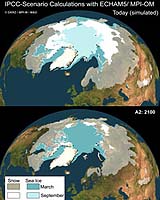
Illustration of how much the arctic ice cap may shrink by the year 2100
Illustration of how much the arctic ice cap may shrink by the year 2100 |
"We've seen models of global climate change for more than 20 years, and they have shown us that warming associated with increased, man-made carbon dioxide emissions will appear first � and be the most intense � in the Arctic," Smith said. "But what extensive satellite imagery confirms is that this Arctic warming is happening already. Permanent ice is thinning, and the duration of ice-free conditions is extending. This is changing currents and affecting feeding patterns and food source availability for the animal life there."
According to Smith, the match of the physical forcing and the life cycles of Arctic marine organisms is crucial; both need to be relatively predictable in time and space for evolution of this food web to have taken place. Global warming is acting to disrupt predictability, a situation that could cause the rapid demise of marine mammals and birds upon which subsistence human populations depend.
A biological oceanographer, Smith has spent her career examining some of the smallest components of food webs. She is the co-director of the National Science Foundation/National Institute of Environmental Health Science Oceans and Human Health Center that is based at the University of Miami Rosenstiel School of Marine and Atmospheric Science as well as a professor in marine biology and fisheries there. Her presentation was part of a session titled, Observations of Anthropogenic Climate Change in the Oceans and their Implications for Society II: Arctic and Ecosystem Responses. Dr. Rana A. Fine, also a UM Rosenstiel School faculty member, presided over the session with Dr. Richard Feely from NOAA's Pacific Marine Environmental Laboratory.
Related Links
 Late Pleistocene Americans Faced Chaotic Climate Change Environments
 University Park PA (SPX) Feb 20, 2006
| The content herein, unless otherwise known to be public domain, are Copyright 1995-2006 - SpaceDaily.AFP and UPI Wire Stories are copyright Agence France-Presse and United Press International. ESA PortalReports are copyright European Space Agency. All NASA sourced material is public domain. Additionalcopyrights may apply in whole or part to other bona fide parties. Advertising does not imply endorsement,agreement or approval of any opinions, statements or information provided by SpaceDaily on any Web page published or hosted by SpaceDaily. Privacy Statement |