
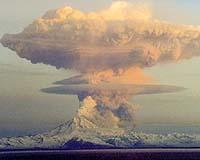
Volcanic eruptions have periodically cooled the tropics over at least the last 450 years by spewing out particles that girdle the world at high altitude and reflect sunlight, according to a study released Sunday.
The research adds a chunk of regional evidence to earlier work that found major eruptions — such as Krakatoa, Indonesia in 1883 and Huaynaputina, Peru in 1600 — contribute to cooling on a worldwide scale.
A trio of scientists led by Rosanne D'Arrigo of the Lamont-Doherty Earth Observatory in Palisades, New York, looked at ocean temperatures in a belt extending from 30 degrees south across the equator to 30 degrees north.
They compiled temperature records reaching back nearly half a millennium from three sources: ice cores, tree rings and coral reefs.
They found the longest sustained period of cooling of sea surfaces — to a depth of one metre (3.25 feet) — occurred in the early 1800s following the eruption of Mount Tambora on the Indonesia island of Sumbawa.
Tambora blew its top in 1815 and was the most powerful eruption in recorded history, ejecting about 50 cubic kilometres (12 cubic miles) of magma, according to the US Geological Survey (USGS).
However, links between volcanic activity and cooler ocean surfaces weakened in the 20th century, apparently as a result of global warming from the burning of fossil fuels, the researchers say.
Another study, also published online in the journal Nature Geoscience, points to a previously unrecognized potential driver of climate change.
Intensive, chemical-laden agriculture could trigger the release of carbon dioxide (CO2) from river systems, Henry Wilson and Marguerite Xenopoulos of Trent University in Ontario Canada argue.
The researchers examined organic, meaning carbon-bearing, matter that had dissolved in 34 rivers in Ontario.
Some of the rivers were pristine and others were heavily polluted by runoff from agricultural chemicals such as fertilizers, insecticides and herbicides.
Pollution from these chemicals meant the organic material was likelier to release its carbon into the atmosphere, the study found.
This factor should be taken into account by climate modelers, the study suggested.
Share This Article With Planet Earth
