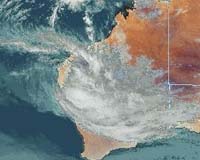
The core drilling samples from Western Australia's Pilbara region were collected by PhD student Lawrie Duck who said it was an amazing experience to "hold in your hands rocks that contain remains of some of the earliest forms of life on Earth."
The core drilling samples from Western Australia's Pilbara region were collected by PhD student Lawrie Duck who said it was an amazing experience to "hold in your hands rocks that contain remains of some of the earliest forms of life on Earth." |
Aspects of the research have been published in the prestigious scientific journal Precambrian Research. "What we have found is the first visual confirmation of primitive microbial communities in what is considered to be the best preserved ancient organic matter on our planet," Dr Glikson, the instigator of the research, said.
Dr Golding, Director UQ's Stable Isotope Laboratory in the Division of Earth Sciences, said previous studies used indirect analytical methods that were only able to suggest microbial involvement, not confirm it.
"We used difficult and time-consuming electron microscope techniques to conclusively confirm the microbial remains," Dr Golding said.
"The integration of observational and micro-analytical techniques is unique to our approach."
The core drilling samples from Western Australia's Pilbara region were collected by PhD student Lawrie Duck who said it was an amazing experience to "hold in your hands rocks that contain remains of some of the earliest forms of life on Earth."
"The Pilbara region is such a good research site as it has ancient forms of the white smokers active at plate margins today and black sulfidic smokers found in sea floor vent systems in tectonically active sites," he said.
"These are the places where scientists believe life on Earth might have had its origins."
Dr Glikson said the UQ team had then taken the study further by comparing the fossil microbial structures to primitive microbes found today in seafloor environments similar to those existing 3.5 billion years ago.
"The microbiologists on the team, led by Dr Sly, cultured currently existing primitive microbes under simulated conditions to those of the ancient forms of life," Dr Glikson said.
"A remarkable resemblance was found between the structures of the cultured microbial entities at their stage of disintegration and those of the ancient microbial remains."
The other members of the UQ research team were Robyn Webb, from the Centre for Microscopy and Microanalysis, a specialist in transmission electron microscopical techniques; Justice Baiano, from the School of Molecular and Microbial Sciences, who developed special facilities to culture primitive microbes derived from seafloor mineral-laden hot springs active at plate margins today; and Kim Baublys, from the Stable Isotope Laboratory, who undertook analysis of products from the culture experiments.
A comparison with organic matter from rocks of similar age in South Africa also yielded microbial remains identical to those from the Pilbara, further confirming the UQ work.
This was achieved with the collaboration of Dr Axel Hofmann from the University of Kwazulu, South Africa and Dr Robert Bolhar formerly of the University of Canterbury, New Zealand.
Community
 Crystals On Meteorite Reveal Clues To Early Solar System Evolution
 Toronto, Ontario (SPX) Aug 07, 2007
| The content herein, unless otherwise known to be public domain, are Copyright 1995-2007 - SpaceDaily.AFP and UPI Wire Stories are copyright Agence France-Presse and United Press International. ESA Portal Reports are copyright European Space Agency. All NASA sourced material is public domain. Additional copyrights may apply in whole or part to other bona fide parties. Advertising does not imply endorsement,agreement or approval of any opinions, statements or information provided by SpaceDaily on any Web page published or hosted by SpaceDaily. Privacy Statement |