
. Earth Science News .


.
FLORA AND FAUNA
A snapshot of pupfish evolution in action
by Staff Writers
Davis CA (SPX) Jan 15, 2013


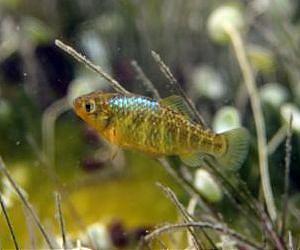
In lakes on the island of San Salvador, Bahamas, pupfish like this one show rapid evolution to exploit new diets. UC Davis graduate student Chris Martin has bred hundreds of hybrid fish to understand the process. Credit: Chris Martin/UC Davis.

Chris Martin has bred more than 3,000 hybrid fish in his time as a graduate student in evolution and ecology at UC Davis, a pursuit that has helped him create one of the most comprehensive snapshots of natural selection in the wild and demonstrated a key prediction in evolutionary biology.

"We can see a surprisingly complex snapshot of natural selection driving the evolution of new specialized species," said Martin, who with Professor Peter Wainwright published a paper on the topic in the Jan. 11, 2013, issue of the journal Science.

The "adaptive landscape" is very important for evolutionary biology, but rarely measured, Martin said. He's been fascinated with the concept since high school.

An adaptive landscape takes variable traits in an animal or plant, such as jaw size and shape, spreads them over a surface, and reveals peaks of success (what evolutionary scientists call fitness) where those traits become most effective, or adaptive.

It is a common and powerful idea that influences thinking about evolution. But while the concept is straightforward, it is much harder to map out such a landscape in the wild.

For example, about 50 species of pupfish are found across the Americas. The tiny fish, about an inch or so long, mostly eat algae on rocks and other detritus.

Martin has been studying species found only in a few lakes on the island of San Salvador in the Bahamas, where some of the fish have evolved different-shaped jaws that allow them to feed on hard-shelled prey like snails or, in one case, to snatch scales off other fish.

In a paper published in 2011, Martin showed that these San Salvadoran fish are evolving at an explosively faster rate than other pupfish.

Martin brought some of the fish back to the lab at UC Davis and bred hybrids with fish with different types of jaws. He created about 3,000 hybrids in all, which were measured, photographed and tagged. Martin then took about 2,000 of the fish back to San Salvador.

"It was the craziest thing I've done," Martin said. "I was leaning on the stack of them in the middle of Miami airport."

Martin released the young fish into enclosures in the lakes of their grandparents. Three months later, he returned to check on the survivors and plotted them out on the adaptive landscape.

Most of the surviving fish were on an isolated peak adapted to a general style of feeding, with another peak representing fish adapted for eating hard-shelled prey. Competition between the fish had eliminated the fish whose jaws put them in the valleys between those peaks. The scale-eating fish did not survive.

The results explain why most pupfish species in America have pretty much the same diets, Martin said. The generalists are essentially stranded on their peak - variants that get too far out fall into the valley and die out before they can make it to another peak.

"It's stabilizing selection," he said. An early burst of variation when fish entered a new environment with little competition could have allowed the shell-eaters and scale-eaters to evolve on San Salvador.

.


Related Links
University of California - Davis
Darwin Today At TerraDaily.com


Comment on this article via your Facebook, Yahoo, AOL, Hotmail login.

Share this article via these popular social media networks
del.icio.usdel.icio.us DiggDigg RedditReddit GoogleGoogle


Memory Foam Mattress Review

Newsletters :: SpaceDaily Express :: SpaceWar Express :: TerraDaily Express :: Energy Daily
XML Feeds :: Space News :: Earth News :: War News :: Solar Energy News

Get Our Free Newsletters
Space - Defense - Environment - Energy - Solar - Nuclear

...


FLORA AND FAUNA
Low extinction rates made California a refuge for diverse plant species
Santa Cruz CA (SPX) Jan 14, 2013
The remarkable diversity of California's plant life is largely the result of low extinction rates over the past 45 million years, according to a new study published in the journal Evolution. Although many new species have evolved in California, the rate at which plant lineages gave rise to new species has not been notably higher in California than elsewhere, researchers found. Botanists ha ... read more


FLORA AND FAUNA
Nineteen children among 46 dead in China landslide

Haiti is recovering, leader tells quake ceremony

Philippines to move 100,000 squatters

Hannover Re hit by 261-million-euro loss from Sandy

FLORA AND FAUNA
Molecular machine could hold key to more efficient manufacturing

Government funding for 'super-material'

How the kilogram has put on weight

Japan to survey Pacific seabed for rare earth

FLORA AND FAUNA
Taiwan mulls shipping water from China as ties improve

Wales, fishermen discuss protection zones

Living cells behave like fluid-filled sponges

Interagency Report Published on Information Required for Short-Term Water Management Decisions

FLORA AND FAUNA
A new approach to assessing future sea level rise from ice sheets

A New Way to Study Permafrost Soil, Above and Below Ground

Bering Sea study finds prey density more important to predators than biomass

Fiennes sails for Antarctica on first winter crossing bid

FLORA AND FAUNA
Farmland Opportunity Includes 17,687 Great Plains Acres

EU releases all data on GM corn linked to cancer

Lady Beetle Diet Influences Its Effectiveness as Biocontrol Agent

Nuclear fears contaminate sales for Japan farmers

FLORA AND FAUNA
Volcano lava flows worry Italian island

Malawi floods kill three, displace thousands

Red-dust sunset as west Australia braces for cyclone

Russian volcano erupting with gas, ash

FLORA AND FAUNA
Sudanese army claims it killed more than 50 rebels

African forces face daunting task in Mali intervention

Mali Islamists flee bases, battered by French airstrikes

Central African PM dismissed after ceasefire deal

FLORA AND FAUNA
Eliminating useless information important to learning, making new memories

Tech world crawling into the crib

Promising compound restores memory loss and reverses symptoms of Alzheimer's

Dopamine-receptor gene variant linked to human longevity


The content herein, unless otherwise known to be public domain, are Copyright 1995-2012 - Space Media Network. AFP, UPI and IANS news wire stories are copyright Agence France-Presse, United Press International and Indo-Asia News Service. ESA Portal Reports are copyright European Space Agency. All NASA sourced material is public domain. Additional copyrights may apply in whole or part to other bona fide parties. Advertising does not imply endorsement,agreement or approval of any opinions, statements or information provided by Space Media Network on any Web page published or hosted by Space Media Network. Privacy Statement