|
 |
 |
 |
 |
 |
 |
 |
 |
 |

| . |  |
. |
Australia Mulls Chinese Request To Explore For Uranium
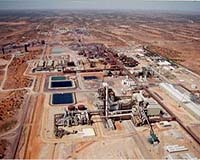
Sydney (AFP) Oct 17, 2005 Australia said Monday that it could give resource-hungry China direct access to its huge uranium deposits if Beijing signs pledges the nuclear material would not be used for military purposes. Foreign Minister Alexander Downer said China asked for permission to conduct uranium exploration and mining in Australia during talks early this year in the Chinese capital. But he said the Chinese plans would have to get past Australia's Foreign Investment Review Board and there would need to be a nuclear safeguards agreement. "We wouldn't be exporting any uranium to China for military purposes of any kind," Downer said on national radio. "By that I don't only mean for use in nuclear weapons, but also we wouldn't be exporting any uranium to China for use in military vessels or vehicles of one kind or another," he said. China has a ravenous appetite for energy to power its rapidly growing economy and is already a major purchaser of Australian coal and natural gas. Chinese officials first asked for access to Australian uranium deposits during meetings in February with the Australian Nuclear Safeguards and Non-Proliferation Office, officials said. The Chinese initiative was revealed Monday by The Age newspaper in Melbourne and then confirmed by Downer, who earlier this year raised the prospect of increasing Australian exports of uranium to help fuel expanding nuclear power industries across Asia, notably in China, South Korea and India. Australia has about 40 percent of the world's known uranium reserves but has only three operating uranium mines, two in South Australia and one in the Northern Territory. The country has no nuclear power industry. The center-left Labor Party, which controls the state and territory governments, has opposed opening more uranium mines. Federal Labor leader Kim Beazely reaffirmed on Monday his party's opposition to opening additional uranium mines, though he said he had "no problems" with exporting uranium to China if security and waste disposal issues could be resolved. "I would say at this stage we're as far into the business as we want to be," he said. "They (the Chinese) have got plenty of opportunity to acquire uranium from current facilities." But Prime Minister John Howard's conservative federal government in August seized control of uranium mining rights in the Northern Territory, giving it the power to grant approvals for exploration and mining activity. Downer said that if barriers to further uranium mining in Australia were lifted, "there's no reason why Chinese companies can't invest in Australian resources industries ... subject to the Foreign Investment Review Board." "If Labor changed its policy, if we had a nuclear safeguards agreement and if the Foreign Investment Review Board approved the investment then they could do it," he said. "But they are, to use a Chinese-style expression, the three ifs." A nuclear proliferation expert expressed strong concern that allowing China to conduct its own uranium operations in Australia would make it difficult to ensure the nuclear material was used only for civilian purposes. "I'm very worried about this," Richard Broinowski told The Age. "I think the Australians are seeing dollar signs all over the place," he said, raising the prospect of China using Australian uranium for power generation so that it would be free to use its own uranium deposits for the military. In 2004, Australia exported 9,648 tonnes of uranium, 39 percent of which went to the United States, 25 percent to Japan, 25 percent to the European Union, 10 percent to South Korea and one percent to Canada. Related Links SpaceDaily Search SpaceDaily Subscribe To SpaceDaily Express  Russia Sees Role For China In Floating Nuclear Plant Project
 Moscow (AFP) Oct 12, 2005
Russia plans to start building floating nuclear power stations next year, possibly with participation by China if domestic financing for the project is insufficient, a senior atomic energy official said Wednesday. |
|
|

| The content herein, unless otherwise known to be public domain, are Copyright 1995-2006 - SpaceDaily.AFP and UPI Wire Stories are copyright Agence France-Presse and United Press International. ESA PortalReports are copyright European Space Agency. All NASA sourced material is public domain. Additionalcopyrights may apply in whole or part to other bona fide parties. Advertising does not imply endorsement,agreement or approval of any opinions, statements or information provided by SpaceDaily on any Web page published or hosted by SpaceDaily. Privacy Statement |