|
 |
 |
 |
 |
 |
 |
 |
 |
 |

| . |  |
. |
Blair Determined To Keep Britain's Nuclear Weapons
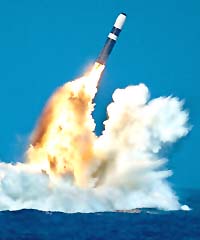
London (AFP) Oct 19, 2005 British Prime Minister Tony Blair said Wednesday that a nuclear deterrent remained a key part of Britain's defence, despite being useless against terrorism. "We're committed to retaining the UK's independent nuclear deterrent," Blair said in reply to a question in parliament on whether he intended to replace the ageing Trident submarine-launched nuclear-tipped ballistic missile system. "Although I don't think anyone pretends that the independent nuclear deterrent is a defence against terrorism, nonetheless I do believe it's an important part of our defence." He admitted that the decision was looming before May 2010 but said that lawmakers would be given the chance to have their say on replacing Trident before the government decides if it will proceed. "No decisions on replacing Trident have yet been taken, but these are likely to be necessary in the current parliament. It is to early to rule in or out any particular option," he said during the weekly prime minister's question time in the House of Commons Blair faces mounting opposition from his fellow Labour Party lawmakers on the renewal of Britain's nuclear deterrent, notably over their cost to build. Faced by accusations in September that he has secretly made a decision to spend up to 20 billion pounds (36 billion dollars, 30 billion euros) on a replacement system, Defence Secretary John Reid insisted: "It is not a decision about which I have received any advice, papers, options or made any decisions." Britain has four Trident submarines in service: Her Majesty's Ships Vanguard, Victorious, Vigilant and Vengeance. They each have 16 multiple warhead nuclear missiles with a range of 12,000 kilometres (7,500 miles). HMS Vanguard successfully fired an unarmed Trident II D5 missile on October 11 during a naval exercise in the Atlantic Ocean. Related Links SpaceDaily Search SpaceDaily Subscribe To SpaceDaily Express  US Support For India's Nuclear Programme Is A One-Off: Official
 Paris (AFP) Oct 19, 2005
Washington's moves to cooperate with India in developing nuclear energy is a one-off situation based on India's "responsible" track record which sets it apart from other aspiring nuclear powers, a senior US official said Wednesday. |
|
|

| The content herein, unless otherwise known to be public domain, are Copyright 1995-2006 - SpaceDaily.AFP and UPI Wire Stories are copyright Agence France-Presse and United Press International. ESA PortalReports are copyright European Space Agency. All NASA sourced material is public domain. Additionalcopyrights may apply in whole or part to other bona fide parties. Advertising does not imply endorsement,agreement or approval of any opinions, statements or information provided by SpaceDaily on any Web page published or hosted by SpaceDaily. Privacy Statement |