|
 |
 |
 |
 |
 |
 |
 |
 |
 |

| . |  |
. |
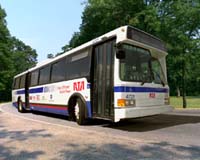
Bus Scheduling Algorithm Picks Up the Slack
Los Angeles CA (SPX) Oct 24, 2007 A prizewinning paper by a USC Viterbi School engineer elegantly solves a basic transit scheduling problem, potentially meaning shorter waits for riders. The question: how much slack should be schedulers of a bus or tram line add to keep operations from bunching up? Maged Dessouky, a professor in the Viterbi School's Daniel J. Epstein department of Industrial and Systems engineering joined with two colleagues to analyze this problem. Slack time is extra time built into a bus schedule to accommodate unexpected delays. The paper published in November 2006 issue of Transportation Science notes, "if slack time is insufficient, buses are unlikely to be able to catch up with the schedule when they fall behind, deteriorating reliability. But too much slack time reduces service frequency, which may inconvenience passengers." For the simplest case, a single vehicle traveling in a loop, the algorithm published in the paper gives an exact number, based on the size of the loop and the distribution of the of the travel time delay. The analysis also provides a way to approximate the effect of adding more busses to the loop. The calculations are not simple. The effects that the equations have to model involve human behavior that is easy to describe, but hard to quantify. For example, if trains or buses are spaced close together (less than 10 minutes apart, typically), travelers tend not to consult schedules or expect vehicles to arrive exactly on time, and buses can leave early without upsetting travel plans. If buses are an hour apart, this isn't true. And delays tend to be cumulative. "Buses on frequent lines have a tendency to bunch ... when a bus falls slightly behind schedule it tends to pick up more passengers, causing it to slow further." While not all effects like this can be modeled, a surprising amount of the dynamics can be captured by abstracting and making simplifying assumptions, according to the paper by Dessouky and co-authors Jiamin Zhao and T.S. Bukkapatnam, both formerly at USC as graduate student and assistant professor respectively. The paper won a "Best Paper for 2007" award from the Institute For Operations Research and Management Science (INFORMS) Transportation Science and Logistics (TSL) Society The work comes off of empirical studies published by Dessouky in 1999 analyzing bus operations at the Los Angeles Metropolitan Transit District. At the time Dessouky measured an average slack time ratio of .25 on three MTA lines - that is, a bus trip scheduled to take an hour generally was accomplished in 45 minutes, with the extra fifteen minutes in the schedule built in to accommodate possible delays. But was the 15 minutes more than necessary? Dessouky later worked with the MTA to incorporate these delay measurements into more effective scheduling, while continuing to try to build the dynamics he found into equations to find out what the optimal level might be. The 2006 paper uses the equations to create curves to correlate average levels of delay and slack time ratios and, by further transpositions, with resulting waiting time for passengers, leading to an approximation of how much slack time is optimal, depending on total round trip travel time. The bottom line - build in between 15 and 20 percent slack, more for longer trips. Dessouky says no transit system is yet using the new algorithms to schedule operations but "our next step which is to make the agencies aware of our approach instead of the current method of using rules of thumb." Dessouky will receive his award November 5, at the INFORMS 2007 Annual Meeting at the Sheraton Seattle Hotel in Seattle, WA. Dessouky is also a member of the Executive Committee for the National Center for Metropolitan Transportation Research (METRANS), a research center at USC and California State University Long Beach that is sponsored by the US Department of Transportation and the California Department of Transportation (Caltrans), which sponsored the research. Earlier this year, Dessouky won the Institute of Industrial Engineers Operations Research Division's Teaching Award. Dessouky collaborator Zhao now has his own company, after working at Oracle; Bukkapatnam is an associate professor at Oklahoma State University's School of Engineering. Community Email This Article Comment On This Article Related Links USC Viterbi School of Engineering National Center for Metropolitan Transportation Research Powering The World in the 21st Century at Energy-Daily.com
 Outside View: Odessa-Gdansk pipeline grows
 Moscow (UPI) Oct 22, 2007
 The success of the informal energy summit held by Azerbaijan, Georgia, Lithuania, Poland and Ukraine in Vilnius, Lithuania, last week will be judged later, when the agreements reached there become reality. (United Press International's "Outside View" commentaries are written by outside contributors who specialize in a variety of important issues. The views expressed do not necessarily reflect those of United Press International. In the interests of creating an open forum, original submissions are invited.) |
|
|

| The content herein, unless otherwise known to be public domain, are Copyright 1995-2007 - SpaceDaily.AFP and UPI Wire Stories are copyright Agence France-Presse and United Press International. ESA Portal Reports are copyright European Space Agency. All NASA sourced material is public domain. Additional copyrights may apply in whole or part to other bona fide parties. Advertising does not imply endorsement,agreement or approval of any opinions, statements or information provided by SpaceDaily on any Web page published or hosted by SpaceDaily. Privacy Statement |