
Subscribe free to our newsletters via your
. Earth Science News .


WATER WORLD
Earth's wobble "fixes" dinner for marine organisms
by Catherine Zandonella, Office of the Dean for Research
Princeton NJ (SPX) Sep 18, 2013


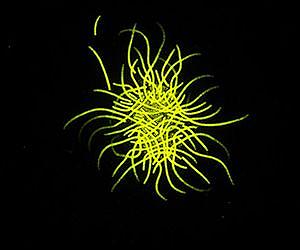
Researchers from Princeton University and the Swiss Institute of Technology in Zurich found that the wobble of the Earth on its axis controls the production of fertilizing nitrogen essential to the health of the ocean. The wobble, known as axial precession, causes an upwell of nitrogen-poor (but phosphorus-rich) water from the deep ocean roughly every 23,000 years. Blue-green algae such as Trichodesmium (above) feed on the phosphorous as they convert, or "fix," nitrogen in the air into a biologically active form that becomes part of the ocean's nitrogen cycle. (Image courtesy of the Center for Microbial Oceanography, University of Hawaii)

The cyclic wobble of the Earth on its axis controls the production of a nutrient essential to the health of the ocean, according to a new study in the journal Nature. The discovery of factors that control this nutrient, known as "fixed" nitrogen, gives researchers insight into how the ocean regulates its own life-support system, which in turn affects the Earth's climate and the size of marine fisheries.

Researchers from Princeton University and the Swiss Institute of Technology in Zurich (ETH) report that during the past 160,000 years nitrogen fixation rose and fell in a pattern that closely matched the changing orientation of Earth's axis of rotation, or axial precession. Axial precession occurs on a cycle of roughly 26,000 years and arises because the Earth wobbles slightly as it rotates, similar to the wobble of a toy top.

Studies from the 1980s revealed that precession leads to a regular upwelling of deep water in the equatorial Atlantic Ocean roughly every 23,000 years. The upwelling in turn brings nitrogen-poor water to the surface where blue-green algae convert nitrogen drawn from the air into a form that is biologically usable.

The finding that nitrogen fixation is determined by precession-driven upwelling appears to indicate that the ocean's fixed nitrogen reservoir is resilient and that the ocean biosphere can recover from even the most dramatic ecological changes, said second author Daniel Sigman, Princeton's Dusenbury Professor of Geological and Geophysical Sciences.

"By studying the response of nitrogen fixation to different environmental changes in the Earth's past, we have found connections that may ensure that the ocean's fixed nitrogen level will always rebound," Sigman said. "This suggests that an ocean over time has a relatively stable nutrient reservoir, and thus stable productivity."

The rise of deep water spurs nitrogen fixation because that water is low in nitrogen but contains an excess of another key nutrient, phosphorus, Sigman said. The phosphorus fuels the fixing of nitrogen carried out by blue-green algae, also known as cyanobacteria.

"The phosphorus-rich, nitrogen-poor water is a boon to cyanobacteria that can fix their own nitrogen," Sigman said. "By growing more rapidly, the nitrogen-fixers 'top up' the fixed nitrogen to the levels needed by other phytoplankton."

Sigman collaborated on the study with Princeton graduate student Mathis Hain; first-author Marietta Straub, Alfredo Martinez-Garcia, A. Nele Meckler and senior author Gerald Haug, all in the Department of Earth Sciences at ETH; and Haojia Ren of the Columbia University Lamont-Doherty Earth Observatory.

The researchers tracked changes in nitrogen fixation in the North Atlantic Ocean by measuring the fixed nitrogen contained in the shells of marine animals recovered from sediment in the Caribbean Sea. Working in Sigman's lab, the investigators measured the amount of two types of nitrogen known as 14N and 15N contained in the shells of tiny marine animal plankton called foraminifera. The ratio of 15N to 14N was then used to reconstruct the rate of nitrogen fixation.

The pattern of nitrogen fixation measured in foraminifera matched the historical record of axial precession and the resulting ocean upwelling. The investigators also compared the fluctuations in nitrogen fixation to historical records of water temperature and levels of iron - another crucial nutrient - both of which influence cyanobacteria survival and thus nitrogen fixation. No correlation was found.

"Our findings suggest that this upwelling was the dominant influence on nitrogen fixation," Sigman said.

Douglas Capone, a professor and chair of biological sciences at the University of Southern California, said that the research is notable both for understanding the nitrogen cycle and for providing a method to study it.

"I have long pondered and hoped for ways to reconstruct deeper historical trends in this important nitrogen-cycle process," Capone said. "The new study by the Sigman and Haug groups is a major breakthrough in providing a means to do this along with throwing light on the major forces of this key process over long time scales."

The paper, "Changes in North Atlantic nitrogen fixation controlled by ocean circulation," was published in Nature Sept. 12. The research was supported by the Swiss and U.S. National Science Foundations and Princeton's Grand Challenges Program.

.


Related Links
Princeton University
Water News - Science, Technology and Politics


Comment on this article via your Facebook, Yahoo, AOL, Hotmail login.

Share this article via these popular social media networks
del.icio.usdel.icio.us DiggDigg RedditReddit GoogleGoogle


WATER WORLD
Mythical sea creature joins bid to ban bottom trawling
Paris (AFP) Sept 16, 2013
Environmentalists on Monday unveiled unprecedented footage of a legendary sea creature, the giant oarfish, as they stepped up a campaign against bottom trawling. The origin of the myth of the sea serpent - a snake deemed capable of capsizing vessels and swallowing crew - the giant oarfish reaches a length of 11 metres (36 feet) and more than 250 kilos (550 pounds). Eel-like in appearan ... read more


WATER WORLD
Obama urges new gun laws, swift Congress action unlikely

US military missed 'red flags' about gunman: Hagel

Flooded Acapulco hit by looting as tourists airlifted

New Technology can Detect Heartbeats in Rubble

WATER WORLD
Yahoo Japan develops 3D search engine-printer

GPS 3 And OCX Satellite Launch and Early Orbit Operations Successfully Demonstrated

'Terminator' polymer that regenerates itself

Northrop Grumman Delivers AEHF Flight 4 Antenna Precision Pointing Unit

WATER WORLD
Wetlands more cost-effective in nutrient removal, but multiple payments would be of uncertain value

Movement of marine life follows speed and direction of climate change

Water supply a problem for New Delhi's poor

Research shows denser seagrass beds hold more baby blue crabs

WATER WORLD
Warm Ocean Rapidly Melting Antarctic Ice Shelf from Below

Russia arrests Greenpeace Arctic activists, fires warning shots

Gas flaring and household stoves speed Arctic thaw

Russia to restore Soviet-era naval base in Arctic: Putin

WATER WORLD
The real reason to worry about bees

Study recommends strategies for improved management of fresh market spinach

Flame cultivation promising as weed control method for cranberry

New weapons on the way to battle wicked weeds

WATER WORLD
New storms loom as tourists seek Acapulco exit

Colorado floods death toll revised down

Airlift launched for tourists in flooded Acapulco

Death toll from Colorado floods rises to eight

WATER WORLD
160 UN peacekeepers desert Mali posts: military

Three Ivorian police killed in attacks

Uganda suspends 24 officers over Somalia corruption

Mali ministers met by hail of stones in Tuareg stronghold

WATER WORLD
Findings in Middle East suggest early human routes into Europe

Paleorivers across Sahara may have supported ancient human migration routes

Orangutans plan their future route and communicate it to others

New evidence that orangutans and gorillas can match images based on biological categories


The content herein, unless otherwise known to be public domain, are Copyright 1995-2014 - Space Media Network. AFP, UPI and IANS news wire stories are copyright Agence France-Presse, United Press International and Indo-Asia News Service. ESA Portal Reports are copyright European Space Agency. All NASA sourced material is public domain. Additional copyrights may apply in whole or part to other bona fide parties. Advertising does not imply endorsement,agreement or approval of any opinions, statements or information provided by Space Media Network on any Web page published or hosted by Space Media Network. Privacy Statement