|
 |
 |
 |
 |
 |
 |
 |
 |
 |

| . |  |
. |
Even A Mile Of Forest Makes A Difference In Water Quality
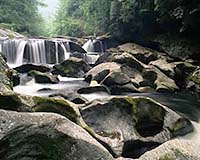
Asheville NC (SPX) Jan 31, 2006 Results from a small-scale experiment in western North Carolina illustrate the importance of National Forest lands in ensuring high water quality in the Southern Appalachian region. Conducted by scientists from the USDA Forest Service Southern Research Station (SRS), the study, published in the January 2006 issue of the journal Water, Air, and Soil Pollution, showed that the quality of water in streams from an area heavily affected by urbanization was significantly improved by its passage through streams flowing in undeveloped forested areas. For the experiment, Jim Vose and Barry Clinton, researchers from the SRS Coweeta Hydrologic Laboratory in Otto, NC, located a setting where a stream carried water from a small town into a fork of the Chattooga River while passing through National Forest land. They set up three sampling sites: the first below the town where the stream enters the National Forest, the second about a mile further down where the stream (now a fork of the Chattooga River) exits the National Forest, and the third reference site on a small, undisturbed stream which lies entirely in the National Forest. "There's a waste treatment facility a little over half a mile up from where the stream enters the National Forest," says Clinton. "We chose the first sampling site to pick up the cumulative effects of wastewater treatment and other non-point pollution sources such as housing developments, stormwater runoff, and roads." Samples were collected weekly for over a year using automated samplers. Data was collected on water chemistry and total suspended solids, particles that range from soil to various types of organic matter. Coming from a wide range of sources, these solids increase after storms, the proportion of this increase one indication of conditions around a stream. The researchers also collected streamwater samples from all the sites to determine bacterial populations. Findings showed a definite "cleaning" affect on the stream from passing through just a mile of National Forest, with evidence of significant reductions in concentrations of chemicals such as nitrates, ammonium, and phosphorous. In response to storms, total suspended solids increased to a higher level at the urban sampling site and stayed higher longer, probably due to more impervious surfaces and land disturbances that increase sediment loading into streams. Bacterial populations did not change much between the two sites, and, though differing greatly from those at the reference site, were well below standards established by the U.S. Environmental Protection Agency. "Factors affecting water quality vary so greatly across landscapes, and we advise caution in applying the specific results of this study to all situations," says Vose. "But the patterns we observed do fit with those found in other studies, and suggest that stream sections in undeveloped forests can improve water quality in areas where the headwaters have been heavily affected by urbanization or other land uses." Related Links USDA Forest Service Southern Research Station  Global Conference On Oceans Opens At UNESCO
 Paris (AFP) Jan 24, 2006
Experts from around the world gathered in Paris Tuesday for a UNESCO conference on oceans, coasts and islands where the focus will be on stemming the erosion of biodiversity and the depletion of fish stocks, the UN's science and education body said. |
|
|

| The content herein, unless otherwise known to be public domain, are Copyright 1995-2006 - SpaceDaily.AFP and UPI Wire Stories are copyright Agence France-Presse and United Press International. ESA PortalReports are copyright European Space Agency. All NASA sourced material is public domain. Additionalcopyrights may apply in whole or part to other bona fide parties. Advertising does not imply endorsement,agreement or approval of any opinions, statements or information provided by SpaceDaily on any Web page published or hosted by SpaceDaily. Privacy Statement |