
. Earth Science News .


.
FLORA AND FAUNA
International ban on polar bear trade rejected
by Staff Writers
Bangkok (AFP) March 7, 2013


A major wildlife meeting of world governments on Thursday shunned calls to ban international trade in polar bears, despite growing fears for the world's largest carnivorous land animal.

A US proposal to add the polar bear to Annex I of the Convention on International Trade in Endangered Species (CITES) was rejected by 42 votes to 38, with 46 abstentions among the nations present for the poll in Bangkok.

Polar bears are currently listed on Annex II of CITES, which imposes strict controls over their international trade.

But the United States -- which along with Canada, Russia, Denmark (Greenland) and Norway hosts a global population of 20,000 to 25,000 polar bears -- wanted to upgrade their status to ban all international trade.

"The polar bear is facing a grim future, and today brought more bad news. The continued harvest of polar bears to supply the commercial international trade is not sustainable," Dan Ashe, director of the US fish and wildlife service, said in response to the rejection.

The proposal, which needed support from a two-third majority, can be re-examined at a plenary session of the 178 CITES member nations next week. A similar bid was unsuccessful at the last CITES meeting in 2010.

About half of the roughly 800 polar bears killed each year end up in the international trade, mostly wild bears from Canada, according to expert estimates cited by the US.

The animals are prized for their skins -- particularly in Russia -- as well as other body parts such as skulls, claws and teeth.

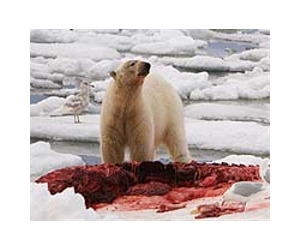
Polar bears are widely seen as the animal on the front lines of global warming and will be hit-hard by melting polar ice caps.

The CITES debate focuses on the additional threat to the species posed by its international trade.

But neither the CITES Secretariat nor some major conservation organisations such as Traffic and WWF supported the US proposal, saying habitat loss from climate change is a far bigger threat.

Canada, which hosts the largest portion of the global population of polar bears, opposes a ban, citing the need to preserve the traditions of the Inuit, an indigenous minority living mostly in the north of the country.

.


Related Links
Darwin Today At TerraDaily.com


Comment on this article via your Facebook, Yahoo, AOL, Hotmail login.

Share this article via these popular social media networks
del.icio.usdel.icio.us DiggDigg RedditReddit GoogleGoogle


Memory Foam Mattress Review

Newsletters :: SpaceDaily Express :: SpaceWar Express :: TerraDaily Express :: Energy Daily
XML Feeds :: Space News :: Earth News :: War News :: Solar Energy News

Get Our Free Newsletters
Space - Defense - Environment - Energy - Solar - Nuclear

...


FLORA AND FAUNA
African elephants face 'alarming declines'
Bangkok (AFP) March 6, 2013
African elephants face the worst crisis since global trade in ivory was banned almost a quarter-century ago, with the risk of extinction rising in worst-hit nations, conservationists said Wednesday. Illicit trade in ivory - driven by organised crime rings - has doubled since 2007 and more than tripled over the past 15 years, experts warned on the sidelines of a major conference on endanger ... read more


FLORA AND FAUNA
Fukushima lags in Japan tsunami recovery: official

Living through a tornado does not shake optimism

Japan riled by WHO's Fukushima cancer warning

Chernobyl plant building to be covered

FLORA AND FAUNA
3D printer wows world's top high-tech fair

Creating your own animated 3D characters and scenes for the web

Towards more sustainable construction

SimCity rebuilt for modern life

FLORA AND FAUNA
Herbal defluoridation of drinking water

80% of Indian sewage flows untreated into rivers: study

New marine species discovered in Pacific Ocean

Shark fin-hungry China drives 'chaotic' fishing in Indonesia

FLORA AND FAUNA
Canada's glaciers could shrink by a fifth by 2100

Remains of extinct giant camel discovered in High Arctic by Canadian Museum of Nature

Robot can help in polar expeditions

Frostbitten British explorer Fiennes returns home

FLORA AND FAUNA
Wild pollinators increase crop fruit set regardless of honey bees

Discovery of genetic mechanism allowing potato cultivation in northern latitudes

Hidden genome unveils how plants adapt to global environments

Spot the difference - oranges and lemons

FLORA AND FAUNA
Floating tsunami trash to be a decades-long headache

Hope and despair as Japan marks tsunami anniversary

Netherlands shares flood control expertise

Q and A on Japan's disaster two years on

FLORA AND FAUNA
UN eases oldest arms embargo to help Somali government

China's Xi to visit S.Africa this month

Independence won, freedom yet to come for South Sudan

Outside View: Kenyan democracy

FLORA AND FAUNA
After the human genome project: The human microbiome project

Walker's World: The time for women

Human cognition depends upon slow-firing neurons

Blueprint for an artificial brain


The content herein, unless otherwise known to be public domain, are Copyright 1995-2012 - Space Media Network. AFP, UPI and IANS news wire stories are copyright Agence France-Presse, United Press International and Indo-Asia News Service. ESA Portal Reports are copyright European Space Agency. All NASA sourced material is public domain. Additional copyrights may apply in whole or part to other bona fide parties. Advertising does not imply endorsement,agreement or approval of any opinions, statements or information provided by Space Media Network on any Web page published or hosted by Space Media Network. Privacy Statement