|
 |
 |
 |
 |
 |
 |
 |
 |
 |

| . |  |
. |
Melting Arctic Ice Risks Canada US Territorial Dispute
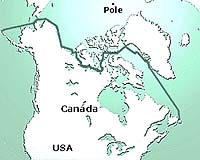
Montreal (AFP) Dec 01, 2005 Global warming is melting the Arctic ice so fast that a new sea route is opening up between the Atlantic and the Pacific -- and with it the risk of a territorial dispute between Canada and the United States. Temperatures around the North Pole are rising twice as fast as in the rest of the planet, according to UN and Canadian government experts. By 2050, they warn, ships will be able to sail around northern Canada for most of the summer. This could reduce the sea trip from London to Tokyo to 16,000 kilometers (9,950 miles), against 21,000 kilometers (13,000 miles) via the Suez Canal or 23,000 kilometers (14,300 miles) going through the Panama Canal. The search for a Northwest Passage to Asia inspired explorers from the 15th to the 17th centuries. Many died. But now greenhouse gases are opening up the passage for them. "There are now more and more ice-free portions of Arctic maritime territory," said Frederic Lasserre, a geographer and specialist on the Arctic, at Laval University in Quebec. If a ship has a reinforced hull, and the winds and currents are in the right direction, it is already "relatively easy" to take the route around the small islands and straights around Canada's Arctic territory, Lasserre added. Arctic temperatures are expected to rise significantly by the end of the century, according to experts, which will melt even more glaciers. "What we are seeing in the Arctic, and what we are seeing further south with the hurricanes, are the most pessimistic models of global warming," said Louis Fortier, an oceanographer who has just returned from an expedition to the region on the Canadian research vessel Amundsen. Lasserre predicted that within 30 years it would probably be possible for ships not normally equipped for the Arctic to tackle the Northwest passage. About 20-30 ships currently take it each summer now. In a territorial dispute now linked to the global warming problem, Canada criticizes the United States, European Union and even Japan for not recognising its 1986 claim of sovereignty to waters around the Arctic archipelago. The United States insists that these are international waters. An American ice-breaker went through the archipelago in 1985 causing a diplomatic dispute with Canada, which reaffirmed its claim to the territorial waters. Canada, which is also arguing with Denmark over a small island off Greenland, based its territorial sovereignty on the ice that then linked all of the Arctic islands. But cracks are quickly forming in the claim. If sovereignty of the Northwest passage ever came before a court, Canada could lose its ability to impose navigational rules in the region. There are huge environmental issues at stake. Canada would be unable to deny passage to any vessel that meets international standards for environmental protection, crew training and safety procedures. The United States argues that all waters between two open seas should be open to all shipping. Lasserre emphasised how the maritime and continental plateau frontier between the United States and Canada has never been formally agreed -- and this will become another looming dispute. The commercial stakes are also high as the Beaufort Sea, which touches the Yukon in Canada and the US state of Alaska, has huge reserves of oil and natural gas. Experts have highlighted how access to these reserves will become a lot easier as global warming increases. Lasserre said that there is more than oil to be found in the Arctic. "There is also gold, diamonds, copper and zinc. There is going to be a lot of traffic caused by the mining exploration," he said. Related Links SpaceDaily Search SpaceDaily Subscribe To SpaceDaily Express  Rapidly Accelerating Glaciers May Increase How Fast The Sea Level Rises
 Santa Cruz CA (SPX) Nov 14, 2005
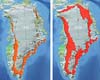
Satellite images show that, after decades of stability, a major glacier draining the Greenland ice sheet has dramatically increased its speed and retreated nearly five miles in recent years. |
|
|

| The content herein, unless otherwise known to be public domain, are Copyright 1995-2006 - SpaceDaily.AFP and UPI Wire Stories are copyright Agence France-Presse and United Press International. ESA PortalReports are copyright European Space Agency. All NASA sourced material is public domain. Additionalcopyrights may apply in whole or part to other bona fide parties. Advertising does not imply endorsement,agreement or approval of any opinions, statements or information provided by SpaceDaily on any Web page published or hosted by SpaceDaily. Privacy Statement |