
WATER WORLD
Most deep-sea animals produce their own light, research shows
by Brooks Hays
Washington (UPI) Apr 10, 2017


There a few ecosystems on Earth where the sun doesn't shine. The largest is the deep sea. Below 1,000 feet, the ocean is pitch black.

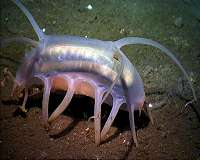
According to new research, the vast majority of creatures found at such depths create their own light.

Researchers from the Monterey Bay Aquarium Research Institute analyzed the footage from 240 dives conducted by the institute's remote-controlled submersibles. The survey identified more than 350,000 individual animals using the Video Annotation and Reference System.

Scientists compared the results of their survey with a database of species known to be bioluminescent and classified the identified individuals into one of five categories: definitely bioluminescent, highly likely to be bioluminescent, very unlikely to be bioluminescent, definitely not bioluminescent and undefined.

The research showed nearly three-quarters of all deep-sea dwellers produce their own light. Surprisingly, scientists say, the percentage of bioluminescent species is consistent at a range of depths. However, the groups of animals responsible for bioluminescence at each depth changes.

Between the surface and roughly 5,000 feet, bioluminescence is mostly produced by jellyfish and comb jellies. Between 5,000 and 10,000 feet, most bioluminescent creatures are marine worm species. Most of the glowing species below 10,000 feet are small sperm-like filter feeders called appendicularians, or larvaceans.

"I'm not sure people realize how common bioluminescence is," MBARI researcher Severine Martini said in a news release. "It's not just a few deep-sea fishes, like the angler fish. It's jellies, worms, squids...all sort of things."

Study authors Martini and Steve Haddock published their work in the journal Scientific Reports.

WATER WORLD
Skeletons developed as chemistry of oceans changed
Edinburgh, UK (SPX) Apr 10, 2017
Skeletons and shells first came into being 550 million years ago as the chemical make-up of seawater changed, a study suggests. Ancient marine life may have developed from soft-bodied animals into creatures with hard body parts as oxygen levels rose and calcium and magnesium levels in prehistoric oceans changed, researchers say. Until now, little was known about how skeletons and shells - ... read more

Related Links
Water News - Science, Technology and Politics

Comment using your Disqus, Facebook, Google or Twitter login.

Share this article via these popular social media networks
del.icio.usdel.icio.us DiggDigg RedditReddit GoogleGoogle

WATER WORLD
Colombia orders protection for musdlide town

Trump's visceral response prompts Syria strikes

Over 6,000 flee 'terrifying' violence in S.Sudan town: UN

After US strikes, Syria attack victims dream of Assad ouster

WATER WORLD
Despite EU fines, Greece struggling to promote recycling

Granites could solve riddle of pinpointing metals crucial for low carbon tech

Seaweed: From superfood to superconductor

More annual shareholder meetings go virtual in US

WATER WORLD
Powers of attraction could decimate deadly starfish

'Zero recovery' for corals in back-to-back Australia bleaching

Most deep-sea animals produce their own light, research shows

UBC invention uses bacteria to purify water

WATER WORLD
Permafrost more vulnerable than thought: scientists

Arctic Ocean becoming more like the Atlantic, scientists say

Microbial colonizers of Arctic soils are sensitive to future climate change

Some of Greenland's coastal ice will be permanently lost by 2100

WATER WORLD
New global report on food crisis

A step forward to making crops drought tolerant

New rice fights off drought

Domesticated rice goes rogue

WATER WORLD
Volcanic arcs form by deep melting of rock mixtures

Panic, damage as three strong quakes hit Philippines

5.1 quake kills one in El Salvador

Project Hotspot

WATER WORLD
Three killed in Mogadishu army camp attack: military

El Nino can warn on cholera outbreaks in Africa: study

Five dead in jihadist attack in Mali

Boko Haram kills eight, abducts women in NE Nigeria: sources

WATER WORLD
Putting social science modeling through its paces

Study reveals 10,000 years of genetic continuity in northwest North America

Married couples with shared ancestry tend to have similar genes

Researchers uncover prehistoric art and ornaments from Indonesian 'Ice Age'