
 |
 |
 |
 |
 |
 |
 |
 |
 |
 |

| . |  |
. |

Provo UT (SPX) Jun 09, 2010 Every minute, 10,000 gallons of water mysteriously gush out of the desert floor at a place called Ash Meadows, an oasis that is home to 24 plant and animal species found nowhere else in the world. A new Brigham Young University study indicates that the water arriving at Ash Meadows is completing a 15,000-year journey, flowing slowly underground from what is now the Nevada Test Site. The U.S. government tested nuclear bombs there for four decades, and a crack in the Earth's crust known as the "Gravity Fault" connects its aquifer with Ash Meadows. It will presumably be another 15,000 years before radioactive water surfaces at Ash Meadows, Nelson said. A more pressing issue for wildlife managers at Ash Meadows is the current decline in populations of Devil's Hole Pupfish and three other endangered fish species. "Since the crust in Western states is being pulled apart east to west, it creates north-south fault lines such as this one that guides groundwater from one geographically closed basin to another," said Stephen Nelson, a BYU geology professor and co-author of the study. The study appears in the May 28 issue of The Journal of Hydrology. Of the possible sources, only water from the Nevada Test Site matched the profile of dissolved minerals and had comparable hydrogen and oxygen isotopes. Water from the Spring Mountains near Las Vegas - previously assumed to be the source of Ash Meadows water - carried a different isotopic signature. The BYU researchers combed through more than 4,000 published water samples from the region, many of those from U.S. Geological Survey wells. From this large data set emerged 246 distinct groundwater sources that they tested against the chemical make-up of water from Ash Meadows. "The results are parsimonious," Nelson said. "A majority of the water at Ash Meadows flows from the north through fractures in the Gravity Fault." Prior to joining the BYU faculty in 1997, Professor Nelson earned a Ph.D. from UCLA and worked as a scientific contractor for the Department of Energy's Yucca Mountain Site Characterization Project. The lead author of the new study is Michelle Bushman, who completed a master's degree in geology at BYU. Bushman also received a J.D. from BYU's J. Reuben Clark Law School.
Share This Article With Planet Earth
Related Links Brigham Young University Water News - Science, Technology and Politics

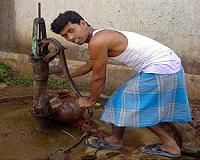 Offering Solutions To Poisonous Well Water Crisis In Southern Asia
Newark DE (SPX) Jun 03, 2010 Over 100 million people in rural southern Asia are exposed every day to unsafe levels of arsenic from the well-water they drink. It more than doubles their risks for cancer, causes cardiovascular disease, and inhibits the mental development of children, among other serious effects. The World Health Organization (WHO) has referred to the situation in Bangladesh, where an estimated 60 millio ... read more |
|
|
| The content herein, unless otherwise known to be public domain, are Copyright 1995-2010 - SpaceDaily. AFP and UPI Wire Stories are copyright Agence France-Presse and United Press International. ESA Portal Reports are copyright European Space Agency. All NASA sourced material is public domain. Additional copyrights may apply in whole or part to other bona fide parties. Advertising does not imply endorsement,agreement or approval of any opinions, statements or information provided by SpaceDaily on any Web page published or hosted by SpaceDaily. Privacy Statement |


 del.icio.us
 Digg
Digg Reddit
 YahooMyWeb
 Google
 Facebook