|
 |
 |
 |
 |
 |
 |
 |
 |
 |

| . |  |
. |
SPD In Crisis, Coalition Doubts Mount
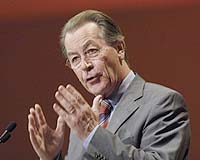
Kehl Am Rhein, Germany (UPI) Nov 01, 2005 Germany is in political uncertainty after two key figures in the coalition negotiations announced they might not join the Cabinet, seriously threatening efforts to form a left-right government. The surprising resignation of Franz Muentefering on Monday from his post as Social Democratic Party chairman has thrown the outgoing Chancellor Gerhard Schroeder's party into a crisis. It has also sparked a political chain reaction that might bury Angela Merkel's leadership hopes. With conservative leader Edmund Stoiber Tuesday confirming speculation he would not make the move to Berlin as the federal economy minister, the plan to form a swift coalition government between the SPD and Merkel's conservative alliance seems to be in serious jeopardy. Germany might face a period of political uncertainty similar to the weeks-long deadlock after the inconclusive Sept. 18 general elections. The crisis unfolded Monday, when Muentefering announced he was not running for re-election at the Nov. 14-16 party summit after the SPD leadership rejected his preferred candidate, Kajo Wasserhoevel, for the post of secretary general. Instead, in a 23-14 decision, left-winger Andrea Nahles was elected to run for the office. The vote was a blow to Muentefering as he had campaigned against her nomination and tried to hand the job to Wasserhoevel, one of his close political allies. "I can no longer be party chairman under these conditions," Muentefering said after the results were made public, adding he was considering not joining the left-right government. "I left my decision open as to whether I will belong to the cabinet after the next party congress." But while Muentefering still might make the move to Berlin, another key figure from the coalition talks won't. In light of Nahles' victory, Christian Social Union head Stoiber on Monday evening warned of "new currents" inside the SPD that might threaten the coalition process and alter the way negotiations were held. On Tuesday, German public television confirmed that Stoiber would remain in his post as state premier of Bavaria and not make the move to Berlin as the next Economy and Technology minister. "We want to bring these negotiations to a successful conclusion, but one can't rule out that they will fail," Wolfgang Bosbach, the parliament's deputy conservative leader, told German public radio. The resignation of Muentefering came shortly after the 65-year-old had amassed a substantial amount of additional political power. Schroeder's retreat to the back benches two weeks ago freed the way for his old ally Muentefering, who had been slated to take on the key roles of work and social minister and vice chancellor in the new coalition. Muentefering, however, was also the SPD's parliamentary faction leader and its party chairman -- too much power some said for one person. "Muentefering made the mistake to continue the dominant leadership style of Gerhard Schroeder," Gero Neugebauer, political expert at Berlin's Free University, Tuesday told United Press International in a telephone interview. "Several decisions were made in the past that failed to acknowledge the party base -- that started with the call for early elections and culminated in Muentefering's support for Wasserhoevel over the press." The vote accurately reflects the generational conflict inside the SPD, Neugebauer said. "Nahles had support not only from her left wing, but also from other young circles in the party," he said. "But one thing is clear: they underestimated the importance of the vote." Several SPD figures criticized the party's leadership, arguing they acted short-sighted. "It was a drastic mistake of the complete SPD leadership," interior policy spokesman Dieter Wiefelspuetz told a German radio station. "The whole thing was unnecessary, needless and very harmful." Nahles indicated Tuesday in a television interview that she might not take on her designated office, in light of the political avalanche she has launched. The SPD seems to remain divided, with some lawmakers demanding a complete shake-up of the party leadership and others calling for Muentefering to rethink his decision. Stoiber's refusal to enter the Cabinet does not come unexpected, as he has had trouble finding a successor to his post in Bavaria and several times hinted he might stay in Munich. It couldn't come at a worse time for coalition negotiations, however, which on Monday had entered the second phase. Should the grand coalition talks fail, the big parties could explore other alliance possibilities with smaller parties like the pro-market Free Democrats or the Green Party. If no government can be formed, the country could face new elections. "That can't be the goal of any of the major parties," Neugebauer said. "The people would likely punish them at the ballots for not being able to overcome their inner-party conflicts and finally form a government. They're sick of it." Related Links SpaceDaily Search SpaceDaily Subscribe To SpaceDaily Express  China Issues Diktat On Democracy
 Beijing (UPI) Oct 21, 2005
China's interpretation of democracy and its future development in a white paper released this week indicates authoritarian Marxism remains the guiding theme. |
|
|

| The content herein, unless otherwise known to be public domain, are Copyright 1995-2006 - SpaceDaily.AFP and UPI Wire Stories are copyright Agence France-Presse and United Press International. ESA PortalReports are copyright European Space Agency. All NASA sourced material is public domain. Additionalcopyrights may apply in whole or part to other bona fide parties. Advertising does not imply endorsement,agreement or approval of any opinions, statements or information provided by SpaceDaily on any Web page published or hosted by SpaceDaily. Privacy Statement |