 |
 |
 |
 |
 |
 |
 |
 |
 |
 |

| . |  |
. |
Sand Chokes Life From Australia's Drought-Stricken Rivers
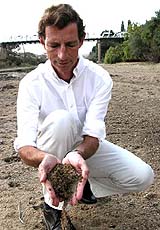
Sydney - Feb 11, 2003 One quarter of rivers in southern Australia are choked with sand where once there were deep pools and rocky bars. Although scientists were surprised to learn the extent of this damage, the same research team has also traced the sources of the sediment, offering hope for future rescue efforts. "We were not expecting the problem to be as large as it is," says CSIRO's Dr Prosser. "The length of river affected, about 30,000 km, is six times the distance from Sydney to Perth. "Sediment loads in many rivers were 5 to 20 times what they were 200 years ago. In the worst areas the load is up to 100 times the natural rate." This is an alarming result for our rivers, and for the plants and animals that live in them. According to Dr Prosser, the sand deposits mean that river life, such as fish, cannot retreat to water holes to survive in times of drought. "The fish are more easily seen by predators such as birds, when they are forced to live in shallower rivers. There is also less food for fish because the sand clogs the spaces between rocks in the river where aquatic insects live." A report for the National Land and Water Resources Audit, based on research by CSIRO Land and Water, spells out the scale of the damage and identifies the origins of the sand. Using a combination of mapping and mineral isotope analysis the CSIRO team found that the sand filling many of our rivers comes from the erosion of the banks of gullies and rivers upstream. These produce more sediment than our rivers can carry, leading to mounting deposits of sand. The same computer mapping techniques that were used to identify the sand deposits are being used to pinpoint the sources of sediment. "The problem is that we need to identify the source of the millions of tonnes of sediment washing into our rivers every year," says Dr Prosser. "The good news is that we can now target the hot spots. Ninety per cent of the sediment problem in our rivers is caused by twenty per cent of the catchment - and if you know which bits, you can run a much more focused catchment restoration plan." The latest advance in pinpointing the sources of the sand offers landholders and governments a real chance to work together under the National Action Plan on Salinity and Water Quality to win back Australia's natural rivers. Related Links SpaceDaily Search SpaceDaily Subscribe To SpaceDaily Express  Ocean Surface Saltiness Influences El Nino Forecasts
 Greenbelt - Jan 31, 2003
NASA sponsored scientists have discovered by knowing the salt content of the ocean's surface, they may be able to improve the ability to predict El Nino events. Scientists, studying the western Pacific Ocean, find regional changes in the saltiness of surface ocean water correspond to changes in upper ocean heat content in the months preceding an El Nino event. Knowing the distribution of surface salinity may help predict events. |
|
|

| The content herein, unless otherwise known to be public domain, are Copyright 1995-2006 - SpaceDaily.AFP and UPI Wire Stories are copyright Agence France-Presse and United Press International. ESA PortalReports are copyright European Space Agency. All NASA sourced material is public domain. Additionalcopyrights may apply in whole or part to other bona fide parties. Advertising does not imply endorsement,agreement or approval of any opinions, statements or information provided by SpaceDaily on any Web page published or hosted by SpaceDaily. Privacy Statement |