|
 |
 |
 |
 |
 |
 |
 |
 |
 |

| . |  |
. |
South Polar Ozone Hole Makes Big Comeback
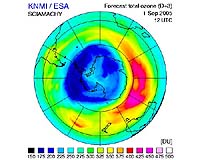
Paris (ESA) Aug 31, 2005 This season's Antarctic ozone hole has swollen to an area of ten million square kilometres from mid-August - approximately the same size as Europe and still expanding. It is expected to reach maximum extent during September, and ESA satellites are vital for monitoring its development. This year's hole is large for this time of year, based on results from the last decade: only the ozone holes of 1996 and 2000 had a larger area at this point in their development. Envisat's Scanning Imaging Absorption Spectrometer for Atmospheric Chartography (SCIAMACHY) routinely monitors ozone levels on a global basis, continuing a dataset of measurements stretching back to mid-1995, previously made by the Global Ozone Monitoring Experiment (GOME) aboard the earlier ESA spacecraft ERS-2. ESA data form the basis of an operational near-real time ozone monitoring and forecasting service forming part of the PROMOTE (PROtocol MOniToring for the GMES Service Element) consortium, made up of more than 30 partners from 11 countries, including the Royal Dutch Meteorological Institute (KNMI). As part of the PROMOTE service, the satellite results are combined with meteorological data and wind field models so that robust ozone and ultraviolet forecasts can be made. In a first for ESA, these results are being used by the World Meteorological Organisation (WMO) to compile their regularly-updated Antarctic Ozone Bulletin. The precise time and range of Antarctic ozone hole occurrences are determined by regional meteorological variations. During the southern hemisphere winter, the atmospheric mass above the Antarctic continent is kept cut off from exchanges with mid-latitude air by prevailing winds known as the polar vortex. This leads to very low temperatures, and in the cold and continuous darkness of this season, polar stratospheric clouds are formed that contain chlorine. The stratospheric ozone layer that protects life on Earth from harmful ultraviolet (UV) radiation is vulnerable to the presence of certain chemicals in the atmosphere such as chlorine, originating from man-made pollutants like chlorofluorocarbons (CFCs). Now banned under the Montreal Protocol, CFCs were once widely used in aerosol cans and refrigerators. CFCs themselves are inert, but ultraviolet radiation high in the atmosphere breaks them down into their constituent parts, which can be highly reactive with ozone. As the polar spring arrives, the combination of returning sunlight and the presence of polar stratospheric clouds leads to splitting of chlorine into highly ozone-reactive radicals that break ozone down into individual oxygen molecules. A single molecule of chlorine has the potential to break down thousands of molecules of ozone. The PROMOTE atmospheric ozone forecast seen here has atmospheric ozone measured in Dobson Units (DUs), which stands for the total thickness of ozone in a given vertical column if it were concentrated into a single slab at standard temperature and atmospheric pressure � 400 DUs is equivalent to a thickness of four millimetres, for example. Developing out of the successful precursor Tropospheric Emission Monitoring Information Service (TEMIS), PROMOTE is a portfolio of information services covering the atmosphere part of the Earth System, operating as part of ESA's initial Services Element of Global Monitoring for Environment and Security (GMES). This is a joint initiative between ESA and the European Commission to combine all available ground- and space-based information sources and develop a global environmental monitoring capability for Europe. Related Links SpaceDaily Search SpaceDaily Subscribe To SpaceDaily Express  Ozone Layer Decline Leveling Off, According To New Study
 Boulder CO (SPX) Aug 30, 2005
A new global study involving long-term data from satellites and ground stations indicates Earth's ozone layer, while still severely depleted following decades of thinning from industrial chemicals in the atmosphere, is no longer in decline. |
|
|

| The content herein, unless otherwise known to be public domain, are Copyright 1995-2006 - SpaceDaily.AFP and UPI Wire Stories are copyright Agence France-Presse and United Press International. ESA PortalReports are copyright European Space Agency. All NASA sourced material is public domain. Additionalcopyrights may apply in whole or part to other bona fide parties. Advertising does not imply endorsement,agreement or approval of any opinions, statements or information provided by SpaceDaily on any Web page published or hosted by SpaceDaily. Privacy Statement |