|
 |
 |
 |
 |
 |
 |
 |
 |
 |

| . |  |
. |
The Science Of Moving Dirt
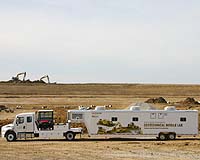
Ames IA (SPX) Dec 08, 2005 It can compact, grind, mix, shake and otherwise analyze the soil and earthworks that support roadways and construction projects. And it can do all that testing right next to the heavy equipment doing all the dirty work. Iowa State University's new Geotechnical Mobile Lab is a $350,000, one-of-a-kind laboratory-on-wheels that allows engineers to study construction sites and come up with immediate answers. Researchers say those answers could lead to more efficient building projects, reduced construction costs, better use of taxpayer investments and better performing roads. "This really allows us to do cutting-edge research and be a national leader in doing geotechnical research," said Tom Cackler, the director of the Partnership for Geotechnical Advancement at Iowa State University's Center for Transportation Research and Education. "It's pretty exciting." Dave White, an Iowa State assistant professor of civil, construction and environmental engineering, recently took the lab to a Minnesota Department of Transportation construction site along U.S. Highway 14 near Janesville, Minn. Engineers used it to do soil compaction tests. They compared the results of their tests with the results from new technology built into a rolling machine. He said the mobile lab provided results twice as fast and allowed all the testing equipment to be right on job site. The lab's 44-foot aluminum trailer includes a diesel generator, a conference area, a satellite Internet system, a laptop computer, a weather station, soil compactors, a soil shaker, a soil grinder, a soil mixer, ovens to dry soil, a vibrating table to test soil density, global positioning technology and lots more. "This provides us the opportunity to conduct research in the field and come back with real-time results," White said. "It also provides the opportunity to train future engineers with state-of-the-art test equipment." Vern Schaefer, an Iowa State professor of civil, construction and environmental engineering, said the lab will help advance what's known as intelligent construction, the use of computer, laser and other technologies to improve the efficiency and quality of construction. Schaefer said the lab will also be useful in testing and verifying new construction equipment and technologies. Departments of transportation often require new ideas be proven before they'll use them on a job site. Heath Gieselman, a research technician for the Center for Transportation Research and Education, recently led a tour of the mobile lab. Everything was in its place. And everything was spotless. That's the way researchers want to keep it, he said. It makes for the best science. It's also a necessity because there's not another lab like it. That means it attracts visitors every time it rolls onto a job site. The lab is sponsored by the McAninch Corp. of West Des Moines. Related Links Iowa State University McAninch Corp. SpaceDaily Search SpaceDaily Subscribe To SpaceDaily Express  Movement Of Earth's North Magnetic Pole Accelerating Rapidly
 Corvallis OR (SPX) Dec 08, 2005
After some 400 years of relative stability, Earth's North Magnetic Pole has moved nearly 1,100 kilometers out into the Arctic Ocean during the last century and at its present rate could move from northern Canada to Siberia within the next half-century. |
|
|

| The content herein, unless otherwise known to be public domain, are Copyright 1995-2006 - SpaceDaily.AFP and UPI Wire Stories are copyright Agence France-Presse and United Press International. ESA PortalReports are copyright European Space Agency. All NASA sourced material is public domain. Additionalcopyrights may apply in whole or part to other bona fide parties. Advertising does not imply endorsement,agreement or approval of any opinions, statements or information provided by SpaceDaily on any Web page published or hosted by SpaceDaily. Privacy Statement |