|
 |
 |
 |
 |
 |
 |
 |
 |
 |

| . |  |
. |
UW-Madison Programmer Gives Weather For The Palm Of Your Hand
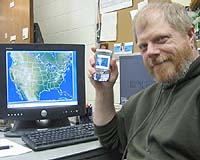
Madison WI (SPX) Jan 16, 2006 Weather lovers have a new tool at hand to obtain weather information on demand through a PDA-friendly weather Web service created by Russ Dengel at the University of Wisconsin-Madison. Dengel's PDA Animated Weather service, known as PAW, benefits a diverse community, from long-haul truck drivers to firefighters in Puerto Rico to commuters trying to get to work safely on a snowy morning. The free service allows PDA users to access real-time radar and satellite weather images and forecasts whenever and wherever. "It's like a meteorologist's dream," says Dengel, a senior information technologist at UW-Madison's Space Science and Engineering Center, where he has access to numerous products. Dengel frequently updates and expands the service's capabilities to meet the needs of his users. "I want to show people what's possible," Dengel says. PAW users can choose from a multitude of geographic regions and data options, including functions like animation, zoom and roam. Recently, he tailored the service to meet the needs of the fire department in Puerto Rico. Dengel set up a radar loop centered on San Juan and added satellite data showing clouds over the area. The PAW, he discovered, is "a fairly decent unit for first responders." He plans to continue to work with fire fighters in Puerto Rico to help them get the most out of the PAW service. Dengel also accommodated the fire department in Boise, ID by outfitting PAW with region-specific radar products. Working with the Wisconsin Department of Transportation, Dengel now offers a PAW version of the DOT's winter road condition information. He created an option that permits users to superimpose road conditions on top of current satellite and radar images. By giving "motorists all the information they need to make good decisions," Dengel makes PAW invaluable to "the average Joe who's driving to work every morning." Winter weather in Wisconsin inspired Dengel to develop PAW. Waiting for a flight out of the Milwaukee airport last winter, Dengel checked the weather in Madison using a service on his cell phone to get an idea of how long it would take to get from the Madison airport to his home in a suburb. While the mobile service indicated no snow in Madison, Dengel arrived to find three inches of snow on the ground and flakes falling rapidly. When he made it into work at the Space Science and Engineering Center, Dengel decided to create a small Web site that allowed him to access radar images using a PDA. In the company of many weather enthusiasts, Dengel expanded the program to meet the needs of several co-workers. However, Dengel soon found out that "nothing can hide on the Web." Only a few months after Dengel made himself a system with a few radar images, hundreds of people from all walks of life began to adopt PAW. With the help of co-workers Bill Bellon and Jerry Robaidek, Dengel created and continues to maintain a dynamic site for the PAW products. In August, over two thousand Web users landed at PAW's humble Internet home. During December, the site received over 100,000 hits. The amount of Web traffic reflects the value of the PAW service. New users keep picking up PAW products and spreading word of the site's usefulness. In response to feedback and suggestions from these users, Dengel constantly adds new products and features. He aims to increase functionality for private pilots and other specialty users. "I'm a meteorologist and I like looking at weather," says Dengel. "I found a lot of people like me." Related Links University of Wisconsin-Madison SpaceDaily Search SpaceDaily Subscribe To SpaceDaily Express  Russia Cold Forces Evacuations
 Moscow (AFP) Jan 15, 2006
Authorities decided Sunday to evacuate children from a village in north Russia after a local boiler plant that provides heating broke down as temperatures plunged to around minus 30 degrees Celsius (minus 22 degrees Fahrenheit), leaving many homes without heat, media reported. |
|
|

| The content herein, unless otherwise known to be public domain, are Copyright 1995-2006 - SpaceDaily.AFP and UPI Wire Stories are copyright Agence France-Presse and United Press International. ESA PortalReports are copyright European Space Agency. All NASA sourced material is public domain. Additionalcopyrights may apply in whole or part to other bona fide parties. Advertising does not imply endorsement,agreement or approval of any opinions, statements or information provided by SpaceDaily on any Web page published or hosted by SpaceDaily. Privacy Statement |