|
 |
 |
 |
 |
 |
 |
 |
 |
 |

| . |  |
. |
Virtual Trip To The Heart Of 400 Million Years Old Microfossils
Paris, France (SPX) Jul 22, 2005 Researchers from the Universit� de Montpellier II (France), the Institute of Geology of China, and the ESRF have been able to identify enigmatic fossils from Devonian (about 400 million years) as fructification of charophyte algae. Charophytes are land plants living in fresh water that still exist nowadays. This breakthrough allows researchers to better understand the evolution of these very old plants of the Paleozoic era and to have an improved overview of the climate at this period. The use of powerful X-rays beams to perform high resolution microtomography at the ESRF was one of the major keys in helping to understand the internal structure of these fossils. The results of this research are published in the latest issue of the American Journal of Botany with the title �New insights into Paleozoic charophyte morphology and phylogeny�. These fossils belong to the enigmatic group of Sycidiales. Since their discovery, in 1934, no one really knew what they actually were. They had been defined as bracken �seeds�, corals or even small crustacean eggs. Thanks to high resolution X-ray synchrotron microtomography on beamline ID19 at the ESRF, the team of scientists succeeded in investigating the three-dimensional structure of these fossils. The samples they used ranged from 500 micron to 4 mm and originated from all around the world. Synchrotron radiation was fundamental for this study since it revealed microscopic details of the internal anatomy of these fossils without damaging them. At present, no other techniques allowing the study of these structures in a non-destructive way are available. Charophytes fructifications exhibit a complex evolution. They all have quite a rounded shape, but the oldest ones display vertical structures on their outside surface, while the most recent ones present spiral ones. Fossils studied during this research are from the Paleozoic (or Primary era) and show these vertical structures. What surprised the researchers was the presence of an utricule, which was known before only in some Mesozoic (secondary era) charophytes. An utricule is a supplementary protective layer believed to protect the zygote (reproductive cell) against desiccation. The fact that such a structure was acquired during the evolution of these very old algae means that they probably lived in a harsh environment. This structure could be interpreted as an adaptation to strong seasonality with dry summers leading to ephemeral aquatic environments. The use of X-ray synchrotron microtomography for this pioneering study on fossil algae opens new doors to paleontology. Indeed, charophytes represent only one group among numerous others of very small fossils. This kind of investigation should hence become a reference for non-destructive three-dimensional approach of small fossils.
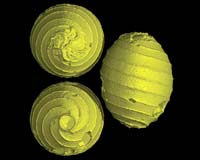
Microtomography: the technique Researchers at the ESRF have presented the possibilities that microtomography offers by showing the steps of a 3D non-destructive investigation by x-ray synchrotron microtomography on a gyrogonite from the Late Cretaceous (Mesozoic) of South of France. This charophyte doesn�t belong to the Sycidiales, but shows the possibilities of X-ray synchrotron microtomography on small fossils. The first step is a high resolution microradiograph (pixel size of 1.4 microns) showing the spirals twisted from base to apex. From a complete set of microradiographs taken during a half rotation, virtual slices are reconstructed (step 2). From all the slices, we obtain a 3D representation of the sample (step 3) showing its external morphology. Step 4 presents the internal cavity after the �virtual� removal of a part of the gyrogonite wall. Using these 3D data, the team reconstructed a virtual mould inside the gyrogonite (step 5). On this virtual oospore (step 6), numerous details are visible, such as the sutures, the apex, or the basal plate. Image number 7 is an observation with a polarizing microscope of a slide in an equivalent sample. Feist et al., New insights into Paleozoic charophyte morphology and phylogeny, American Journal of Botany 92 (7): 1152-1160, 2005. Related Links European Synchrotron Radiation Facility SpaceDaily Search SpaceDaily Subscribe To SpaceDaily Express  Researchers Discover Half-Billion Year-Old Fossils
 Blacksburg, VA (SPX) Jul 12, 2005
Scientists interested in ancient life have a wealth of fossils and impressions frozen in rocks that they can study from as far back as 540 million years ago � when animals with shells and bones began to become plentiful. But evidence of complex life older than 540 million years is scant and difficult to study. |
|
|

| The content herein, unless otherwise known to be public domain, are Copyright 1995-2006 - SpaceDaily.AFP and UPI Wire Stories are copyright Agence France-Presse and United Press International. ESA PortalReports are copyright European Space Agency. All NASA sourced material is public domain. Additionalcopyrights may apply in whole or part to other bona fide parties. Advertising does not imply endorsement,agreement or approval of any opinions, statements or information provided by SpaceDaily on any Web page published or hosted by SpaceDaily. Privacy Statement |