
. Earth Science News .
TECTONICS
What makes the Earth's surface move?
by Staff Writers
Paris, France (SPX) Oct 31, 2019

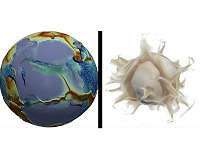
In the image on the left, the modelled fictional planet looks much like the Earth: its surface and mantle move spontaneously, at speeds close to those observed on Earth. The distribution of the plates (some of which are large, while many are small) is also similar, as is the topography: red hues represent shallow regions of the ocean (ridges), while blue indicates the deep seafloor. The deepest blue areas correspond to subduction trenches (where a plate is sinking into the mantle). The continents are shown in translucent white (and therefore appear purplish grey).

Do tectonic plates move because of motion in the Earth's mantle, or is the mantle driven by the movement of the plates? Or could it be that this question is ill-posed? This is the point of view adopted by scientists at the Ecole Normale Superieure - PSL, the CNRS and the University of Rome 3, who regard the plates and the mantle as belonging to a single system.

According to their simulations, published in Science Advances on October 30, 2019, it is mainly the surface that drives the mantle, although the dynamic balance between the two changes over supercontinent cycles.

Which forces drive tectonic plates? This has remained an open question ever since the advent of plate tectonic theory 50 years ago. Do the cold edges of plates slowly sinking into the Earth's mantle at subduction zones cause the motion observed at the Earth's surface?

Or alternatively, does the mantle, with its convection currents, drive the plates? For geologists, this is rather like the problem of the chicken and the egg: the mantle apparently causes the plates to move, while they in turn drive the mantle...

To shed light on the forces at work, scientists from the Geology Laboratory of the Ecole Normale Superieure (CNRS/ENS - PSL), the Institute of Earth Sciences (CNRS/Universities Grenoble Alpes and Savoie Mont Blanc/IRD/Ifsttar) and the University of Rome 3 treated the solid Earth as a single indivisible system and carried out the most comprehensive modelling to date of the evolution of a fictional planet very similar to the Earth.

The scientists first had to find the appropriate parameters, and then spend some nine months solving a set of equations with a supercomputer, reconstructing the evolution of the planet over a period of 1.5 billion years.

Using this model, the team showed that two thirds of the Earth's surface moves faster than the underlying mantle, in other words it is the surface that drags the interior, while the roles are reversed for the remaining third. This balance of forces changes over geological time, especially for the continents.

The latter are mainly dragged by deep motion within the mantle during the construction phases of a supercontinent, as in the ongoing collision between India and Asia: in such cases, the motion observed at the surface can provide information about the dynamics of the deep mantle. Conversely, when a supercontinent breaks up, the motion is mainly driven by that of the plates as they sink down into the mantle.

The computation contains a wealth of data that remains largely unexploited. The data obtained could help us to understand how mid-ocean ridges form and disappear, how subduction is triggered, or what determines the location of the plumes that cause vast volcanic outpourings.

Research paper


Related Links
Centre national de la recherche scientifique
Tectonic Science and News


Thanks for being here;
We need your help. The SpaceDaily news network continues to grow but revenues have never been harder to maintain.

With the rise of Ad Blockers, and Facebook - our traditional revenue sources via quality network advertising continues to decline. And unlike so many other news sites, we don't have a paywall - with those annoying usernames and passwords.

Our news coverage takes time and effort to publish 365 days a year.

If you find our news sites informative and useful then please consider becoming a regular supporter or for now make a one off contribution.
SpaceDaily Contributor
$5 Billed Once


credit card or paypal
SpaceDaily Monthly Supporter
$5 Billed Monthly


paypal only


TECTONICS
Why are mountains so high?
Stanford CA (SPX) Sep 24, 2019
Over millions of years, Earth's summits and valleys have moved and shifted, resulting in the dramatic landscapes of peaks and shadows we know today. Mountains often form when pressure under Earth's surface pushes upward, yet many factors impact their ultimate height, including the erosion of the areas between mountains, known as channels. Scientists have long assumed that as land is pushed faster upward to form a mountain, its height increases in a continuous and predictable way. But new research ... read more

Comment using your Disqus, Facebook, Google or Twitter login.


Share this article via these popular social media networks
del.icio.usdel.icio.us DiggDigg RedditReddit GoogleGoogle

TECTONICS
American CEO faces French lawmakers over chemical plant blaze

Rescuers hunt for missing as landslides, floods kill 10 in Japan

World first study now separates living from the dead

Belgium, transit route for migrant smugglers

TECTONICS
Rethinking the science of plastic recycling

Drexel researchers develop coal ash aggregate that helps concrete cure

Magnets sustainably separate mixtures of rare earth metals

NASA taps telecommunications technology to develop more capable, miniaturized spectrometer

TECTONICS
Mountain streams emit surprisingly large amounts of CO2

Solomons vetoes Chinese 'lease' on Pacific island

South Africa imposes water restrictions as 'Day zero' looms

Laos hydro project switched on along dried-out Mekong

TECTONICS
Reframing Antarctica's meltwater pond dangers to ice shelves and sea level

Photos taken century apart show stark Mont Blanc glacier melt

Antarctic mist as frozen continent bursts into season of light

How can space chart the future of a warming Arctic Circle?

TECTONICS
Trump vows China trade deal will help farmers

Kashmir row sparks Malaysia, India palm oil tensions

Scientists publish strategy for carbon neutral land sector by 2040

A roadmap to make the land sector carbon neutral by 2040

TECTONICS
Strong quake kills two in south Philippines

British woman among three dead in French floods: ministry

Geologists locate source of chemical signature in ancient volcanic rocks

Magma crystallization causes basaltic eruptions to turn explosive

TECTONICS
Guns and smiles: Russia flaunts firepower at Africa summit

Tanzania arrests 4 Chinese over 'slow construction projects

Climate change amplifies conflicts, hinders peacebuilding: Somalia report

Six Burkina troops killed in ambushes

TECTONICS
Marmosets can learn, adopt new dialects

Tar-covered flint tool suggests Neanderthals were surprisingly innovative

Scientists find early humans moved through Mediterranean earlier than believed

Human brain, braincase evolved independently, researchers say


The content herein, unless otherwise known to be public domain, are Copyright 1995-2024 - Space Media Network. All websites are published in Australia and are solely subject to Australian law and governed by Fair Use principals for news reporting and research purposes. AFP, UPI and IANS news wire stories are copyright Agence France-Presse, United Press International and Indo-Asia News Service. ESA news reports are copyright European Space Agency. All NASA sourced material is public domain. Additional copyrights may apply in whole or part to other bona fide parties. All articles labeled "by Staff Writers" include reports supplied to Space Media Network by industry news wires, PR agencies, corporate press officers and the like. Such articles are individually curated and edited by Space Media Network staff on the basis of the report's information value to our industry and professional readership. Advertising does not imply endorsement, agreement or approval of any opinions, statements or information provided by Space Media Network on any Web page published or hosted by Space Media Network. General Data Protection Regulation (GDPR) Statement Our advertisers use various cookies and the like to deliver the best ad banner available at one time. All network advertising suppliers have GDPR policies (Legitimate Interest) that conform with EU regulations for data collection. By using our websites you consent to cookie based advertising. If you do not agree with this then you must stop using the websites from May 25, 2018. Privacy Statement. Additional information can be found here at About Us.