|
 |
 |
 |
 |
 |
 |
 |
 |
 |

| . |  |
. |
Who Laid The First Egg
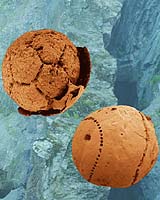
Blacksburg VA (SPX) Jan 24, 2007 A decade ago, Shuhai Xiao, associate professor of geosciences at Virginia Tech, and his colleagues discovered thousands of 600-million-year-old embryo microfossils in the Doushantuo Formation, a fossil site near Weng'an, South China. In 2000, Xiao's team reported the discovery of a tubular coral-like animal that might be a candidate for parenthood. While there are thousands of early-stage embryos, there are only 80 have been recovered that have advanced to an intermediary stage of development. The intermediary stage embryos have an envelope similar to that of earlier embryonic stage, and they have a coiled tubular embryo within the envelope. Their envelope has a groove on the surface, consisting of three clockwise coils. Using microfocus X-ray computed tomography (microCT) imaging, the scientists virtually peeled off the envelope and exposed the embryo inside. The tubular embryo is also coiled, with three clockwise coils. In some specimens, the scientists found signs of uncoiling. "This is further evidence that these embryos would have grown into the tubular organisms," Xiao said. In the article, the researchers state, "... if this possibility holds up to further testing, the new fossils may bridge the developmental gap between two previously described Doushantuo forms." "The discovery of additional intermediary stages and even more advanced specimens would be the ultimate test," Xiao said. But the conditions that preserved the ancient embryos may not have been favorable for preserving or fossilizing more developed life forms, the researchers note. Connecting the first moments of animal evolution will likely require more use of advanced imaging techniques. In the February issue of Geology, the journal of the Geological Society of America, Xiao will report discoveries about the intermediary stage that links the embryo to the adult. (Cover story "Rare helical spheroidal fossils from the Doushantuo Lagerstatte: Ediacaran animal embryos come of age?" by Xiao, James W. Hagadorn of Amherst, and Chuanming Zhou and Xunlai Yuan of Nanjing Institute of Geology and Paleontology.) Related Links Virginia Tech Explore The Early Earth at TerraDaily.com  When The Ocean Breathed Deep
 Los Angeles CA (SPX) Jan 03, 2007
Geologists have uncovered evidence in the oil fields of Oman that explains how Earth could suddenly have changed 540 million years ago to favor the evolution of the single-celled life forms to the multicellular forms we know today. The research yields new information about how past life has interacted with and evolved alongside the changing environment of Earth. |
|
|

| The content herein, unless otherwise known to be public domain, are Copyright 1995-2006 - SpaceDaily.AFP and UPI Wire Stories are copyright Agence France-Presse and United Press International. ESA PortalReports are copyright European Space Agency. All NASA sourced material is public domain. Additionalcopyrights may apply in whole or part to other bona fide parties. Advertising does not imply endorsement,agreement or approval of any opinions, statements or information provided by SpaceDaily on any Web page published or hosted by SpaceDaily. Privacy Statement |