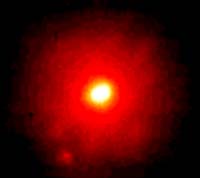
 Note the little blip in the lower left. M. E. Brown and J. L. Margot, California Institute of Technology, report the discovery of a satellite to (87) Sylvia. The projected separation between primary and secondary was 0.59'' in H-band images obtained on 2001 Feb 18.5 UT using the adaptive optics system on the 10-m W. M. Keck II telescope on Mauna Kea. Little relative motion was apparent in images obtained an hour apart (upper limit 0.02''). The brightness ratio was measured to be 420+/-70, implying a ~1:20 ratio of sizes. |
Pasadena - March 7, 2001
Yet another of the rare astroidal binaries has been spotted. Caltech astronomers Mike Brown and Jean-Luc Margot found the newly discovered moon orbiting asteroid (87) Sylvia.
Groups from the University of California, Berkeley; Towson University in Maryland; and the Hubble Space Telescope have confirmed the sighting.
Sylvia and its moon join only six other known asteroids with companions. Five of the other moons were discovered within the last year.
A survey of 500 asteroids led by William Merline of the Southwest Research Institute turned up only two with moons.
"We looked at 28 asteroids," Dr. Brown stated, "and we found one [with a satellite]. This one was pretty easy to spot."
A preliminary analysis shows that the moon is about 1/20th the size of Sylvia with orbits of approximately four days.
More observations will allow the astronomers to calculate the orbit more exactly and from that derive the mass of the two-body system.
An adaptive optics system on the Keck II telescope provided the extraordinary image that revealed the moon.
Using adaptive optics, observers can correct for the turbulence in the atmosphere that causes stars to twinkle and reduces the crispness of telescope images.
Mark Perew is editor of ScienceMasters, which delivers profiles of the people behind the science headlines.
Related Links
TerraDaily
Search TerraDaily
Subscribe To TerraDaily Express

 Boulder - Oct. 26, 2000
Large telescopes with deformable optics are allowing astronomers to study distant asteroids with unprecedented clarity -- leading to the discovery of new shapes and configurations and presenting scientists with new puzzles to solve.