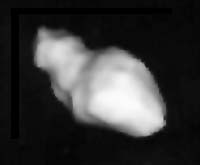
JPL radar image of Toutatis
JPL radar image of Toutatis |
"With improved technology, we are swamped with the discovery of near-Earth asteroids," said Derek Sears, director of the Arkansas-Oklahoma Center for Space and Planetary Sciences. "What we need now is some ground-based data to help select possible asteroids for this mission."
The mission, dubbed Hera after the mother of the Three Graces, would send a spacecraft to three near-Earth asteroids, collect material from them and return it to Earth for research purposes. The researchers plan to propose the mission to NASA within the next 12 months.
Leon Gefert of NASA's Glenn Research Center has calculated about 60 possible trajectories for the mission, where the spacecraft would follow a path to collect samples from the three asteroids and then return to Earth
From this data, Sears and his colleagues have created a "hot list" of asteroids that appear more than once in these trajectories, and now they are seeking information about them.
The researchers need spectral information to determine which trio of asteroids might prove most scientifically interesting and information about the asteroids' orbits around the sun to determine the most efficient travel path to keep fuel expenditures low.
Other information essential to the mission includes the asteroid's size, shape and rotation state. This will help determine where the spacecraft might land on the asteroid and how it would obtain sample material, Sears said.
The researchers are also combing international databases containing information about known near-Earth asteroids for information pertinent to their mission.
Related Links
 New Eros Maps Traces Source Of Most Surface Rocks
 Ithaca - Sept 27, 2001
 Cameron Park - Sept. 3, 2001
 Sydney - Aug 30, 2001