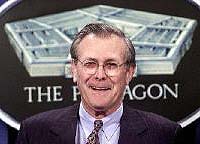
US Defense Sec. Donald Rumsfeld File photo. Copyright AFP 2001
US Defense Sec. Donald Rumsfeld File photo. Copyright AFP 2001 |
"Let's be very honest about what Russia is doing," Rumsfeld said in an interview with PBS television. "Russia is an active proliferator.
"They are selling and assisting countries like Iran and North Korea, and India and other countries with these technologies which are threatening other people including the US, Western Europe, and countries in the Middle east."
At the same time, he added, the Russians are "complaining when the US wants to defend itself against the fruits of these proliferation activities."
Russia's criticism, Rumsfeld said, "seems to me is misplaced."
He said Moscow had no reason to feel threatened by the National Missile Defense plan (NMD) because it could only stop a "handfuls" of enemy missiles, not the thousands the Russians possess.
On Wednesday, Russia's Defense Minister Igor Sergeyev said US plans to build NMD in contravention of the 1972 Anti-Ballistic Missile (ABM) treaty would threaten "not just Russia, but the whole world."
Sergeyev said the very first step towards deploying the controversial NMD system would spell the immediate demise of the 1972 treaty, a cornerstone of arms control for three decades.
The missile defense initiative, a pet project of new US President George W. Bush, is designed to protect the United States and its allies from missile attacks by rogue nations such as North Korea, Iran or Iraq.
The NMD and the Middle East are slated to top the agenda of discussions between US Secretary of State, Colin Powell, and Russian Foreign Minister, Igor Ivanov, when they meet February 24 in Cairo.
Washington's European allies, as well as China, are opposed to NMD development fearing it could rekindle the nuclear arms race.
But Rumsfeld, who recently made his first contact as US Defense Secretary with the members of the North Atlantic Treaty Organization in Munich, Germany, was unconvinced.
The capitals of Europe and the West, he told PBS, are facing very different threats from those of the Cold War: a proliferation of cruise missiles, weapons of mass destruction and terrorism.
The United States' allies, Rumsfeld said, are just as aware as Washington that vulnerability is no longer a good strategy.
Related Links
 China Slams US Missile Plans
 Beijing (AFP) Feb. 6, 2001