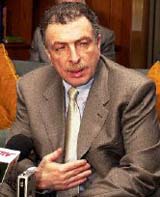
Russian deputy Prime Minister Ilya Klebanov. AFP photo by R. Raveendran
Russian deputy Prime Minister Ilya Klebanov. AFP photo by R. Raveendran |
The NMD project will be "one of the main issues" at a planned Russian-U.S. summit this summer, Deputy Prime Minister Ilya Klebanov told a news conference in Moscow.
The summit, to be held in Genoa, Italy, will be the first meeting between the Russian and U.S. presidents, Vladimir Putin and George W. Bush.
The United States may withdraw from the 1972 Anti-Ballistic Missile (ABM) Treaty if the planned NMD materializes. Klebanov said this may seriously destabilize the global situation and "create a new morality for humankind that the world has not yet gotten used to."
He expressed hope that international debates would persuade the United States to drop the project.
But if Washington goes ahead with it, Russia will have an "inexpensive and sufficiently effective response," he said, without going into details.
"The basis for this response was laid the moment the U.S. announced its plans for creating an NMD, and earlier on, in the ideology for the creation of strategic missile systems," the minister said.
"It is an inexpensive and sufficiently effective response" but "it would be better if it didn't have to be made," he said.
Meanwhile in a recent opinion poll most Russians think U.S. national missile defense system would threaten Russia. According to the poll an absolute majority of Russian citizens (71.6%) are convinced that the deployment of a national missile defense system by the U.S. is a threat to Russia's security.
This is clear from the results of an opinion poll published by the ROMIR-Gallup International independent center for public opinion and market research.
The poll was held at the end of March and involved 2,000 adult citizens. Only 13.8% of the respondents think that the national missile defense system poses no threat to Russia, and 14.6% were undecided.
 Copyright 2001 Interfax. All rights reserved. The material on this page is provided by Interfax and may not be published, broadcast, rewritten or redistributed.
Related Links
 Russian General Touts Western Support For Euro-Shield
 Moscow (Interfax) April 8, 2001