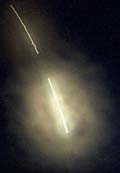
File picture of an earlier missile test at Vandenberg AFB
File picture of an earlier missile test at Vandenberg AFB |
Operational booster design and systems engineering work is done by Boeing in Anaheim, Calif. Boeing in Huntsville, Ala., is responsible for the integration, assembly, test and check out of the developmental booster vehicle.
The booster vehicle is a three-stage commercial-off-the-shelf missile integrating motors from Alliant Techsystems (first stage) and Pratt & Whitney Chemical Systems Division (second and third stages.) The objectives of this first flight test included verifying launch operations and procedures and completing a three-stage flyout and separation. Initial assessments indicate that all objectives were met.
"We are very pleased with the results of today's flight test," said Jim Evatt, executive vice president and general manager of the GMDS program. "The successful first launch of this prototype booster vehicle brings us one step closer to the final integrated system for the ground-based program."
The GMDS program involves the development, testing and potential deployment of a system to detect, track and destroy hostile intercontinental ballistic missiles before they can reach any of the 50 states.
Boeing, as prime contractor, is responsible for the development and integration of the GMDS elements, including the Ground-Based Interceptor, X-Band Radar, Battle Management Command, Control and Communication systems, Upgraded Early Warning Radars and interfaces to the Space-Based Infrared System Satellites. Major team members include Raytheon Company (kill vehicle, radars); TRW (BMC2); and Lockheed Martin Missiles & Space (Payload Launch Vehicle).
The Joint Program Office of the Department of Defense Ballistic Missile Defense Organization directs the Ground-based Midcourse Defense Segment program.
Related Links
 US Missile Test Ends In A Kill
 Washington (AFP) July 15, 2001