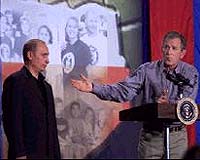
The United States and Russia failed to reconcile differences over the Anti-Ballistic Missile Treaty during their summit, but US President George W. Bush insisted it would not cause a rift between the two nations.
The 1972 ABM treaty, which Russian President Vladimir Putin wants to adhere to, forbids Bush's planned US missile shield.
"We have a difference of opinion (on the treaty), but our relationship is strong enough to endure this disagreement," Bush declared at a joint press conference here with Putin Thursday.
"This agreement will not divide us as nations combined to make the world more peaceful and more prosperous."
For his part, Putin said that Russia's position on missile defense "remains unchanged," but added that he and Bush would continue dialogue and consultations.
Later, in New York, where Putin visited the site of the destroyed World Trade Center, flattened in September 11 terrorist strikes against the United States, the Russian leader explained his attachment to the 1972 ABM treaty.
"Our position, Russia's position, comes down to the fact that the best, the most optimum way is to preserve the agreements that have been signed and put into effect before, and to develop the international agreements and the courts in the security area," he said.
"We also believe that the 1972 treaty that we have now is flexible enough for us to use it for different kinds of efforts toward a greater level of security both for the United States and Russia."
Other parts of the "optimum road" is curtailing nuclear and missile technology proliferation and reducing arms, he said, in an interview with NPR radio in New York.
Putin acknowledged that, "... we do have a common platform on which we can engage in a discussion and to decide what the optimum way is of providing security for both our two countries and the rest of the world.
The United States is committed to developing and deploying a missile shield to thwart attacks by so-called "rogue states" like Iraq or North Korea.
But testing may put the United States in breach of the accord by year-end.
At the meeting, the fourth between the two leaders, Bush said that he and the Russian president had, nonetheless, made significant progress in some areas.
"We have made a lot of progress on coming together on some key issues. There's more work to be done," Bush said.
In a reference to the war on terrorism he said a common Russian-US objective was "to defeat the evil ones that try to terrorize governments such as the United States and Russia."
Bush also accepted an invitation from Putin to visit Russia.
All rights reserved. � 2000 Agence France-Presse. Sections of the information displayed on this page (dispatches, photographs, logos) are protected by intellectual property rights owned by Agence France-Presse. As a consequence, you may not copy, reproduce, modify, transmit, publish, display or in any way commercially exploit any of the content of this section without the prior written consent of Agence France-Presse.