An attempt to intercept a long-range missile over the Pacific Saturday will not be a "pass/fail" test for an operational missile defense system but an effort to learn more, the Pentagon said Friday.
Saturday's test marks a fifth attempt to intercept an intercontinental missile with another missile -- already achieved twice, most recently on July 14.
If all goes well, an interceptor missile fired from an atoll in the South Pacific will destroy a mock warhead 30 minutes after its launch from Vandenberg Air Force Base in California atop an intercontinental missile, the Pentagon said.
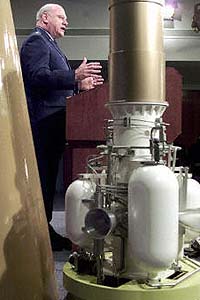
"We are testing to learn," said Air Force Lieutenant General Ronald Kadish, director of the Ballistic Missile Defense Organization. "We are not testing as pass/fail for some operational reason."
Though the ground-based interceptor is the most advanced system in development by the United States, it is no longer the centerpiece of a crash program to deploy a limited defense against ballistic missiles by 2005, as it was during the previous administration.
Instead, the Bush administration has said it intends to pursue development of a wide range of missile defenses, and is pressing Russia to lift restrictions on development, testing and deployment of such systems that currently exist under the 1972 Anti-Ballistic Missile treaty.
The Pentagon had planned to use an Aegis radar aboard a surface ship and early warning radars in California to track the upcoming test, but last month scrapped those activities to stay in compliance with the treaty.
"There's an awful lot of activity that we are rethinking because of the treaty issues," said Kadish.
"All of those have to go through a compliance review. I wouldn't say at this point any of them are critical to what we do tomorrow in terms of the objectives we set. But in the future I can't say," he said.
Saturday's test will be virtually identical to two previous tests.
A modified Minuteman missile will launch a large balloon decoy along with the mock warhead bearing a GPS transponder, allowing it to be tracked across the Pacific by radar.
Armed with that data, an interceptor missile is to be fired from Kwajalein atoll in the Marshall Islands, releasing a "kill vehicle" into an intercept basket some 144 miles (230 kilometers) over the Pacific.
Using infrared sensors, the "kill vehicle" is supposed to seek out the warhead, distinguish it from the balloon decoy, and maneuver itself into a pulverizing collision with the warhead at a closing speed of some 24,000 kilometers (15,000 miles) per hour.
Critics have called the tests unrealistic and rigged to succeed.
"Hit-to-kill has been demonstrated but not under conditions that are operationally relevant," said the Union of Concerned Scientists in a paper released Friday.
But Kadish said such criticism misunderstands the purpose of the tests, which he said is to yield data to allow problems to be identified and corrected, rather than to represent an actual threat.
"We're learning about the systems. We'll make corrections as a result of any anomalies," he said.
"If we have success tomorrow, even if there is an anomaly of some sort, as we expect with a lot of the tests, it will increase our confidence to move on to more aggressive and complicated efforts," Kadish said.
The next test is scheduled for February.