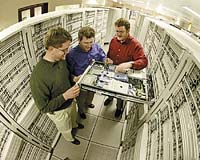
the next total war could take place in cyberspace within racks of computers across the world
the next total war could take place in cyberspace within racks of computers across the world |
The SRS program will develop cognitive technologies enabling military systems to learn,regenerate themselves, and automatically improve their ability to deliver critical services. Selfregenerative systems will show a positive trend in reliability, actually exceeding initial operating capability and approaching a theoretical optimal performance level over long time intervals.
SRS technology will make possible advanced military systems that remain potent for extended deployment periods even in the face of sophisticated and sustained attack. The program is envisioned to last 18 months.
To achieve the SRS program goals, the program will address four key technology areas:
� Biologically Inspired Diversity. In this technical area, the program will reduce the leverage available to adversaries by generating many variants of a system component that perform the same desired functions but are sufficiently different in their vulnerabilities so that a single attack can only damage a small part of an entire system. Two projects were selected in this area: University of Virginia, Charlottesville, Va.; and Global Infotek Inc., Reston, Va.
� Cognitive Immunity and Regeneration. The goal in this technical area is to develop cognitive techniques that introspect about a system's operation, that recognize damage resulting from successful attack, and that reason about appropriate countermeasures. Through such techniques, the program will build systems that automatically recover and regenerate their operational capability, even in the face of continuing attack. Four projects were selected in this area: Massachusetts Institute of Technology Computer Science and Artificial Intelligence Laboratory, Cambridge, Mass. (three projects selected); and Honeywell Labs, Minneapolis, Minn.
Related Links
 New Marking Process Traces Spammers, Pirates And Hackers
 University Park - Apr 01, 2004