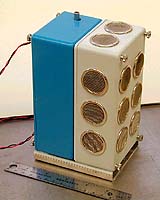
an example of a fuel cell for space applications
an example of a fuel cell for space applications |
The effort is part of a Defense Advanced Research Projects Agency, or DARPA, "Water Rocket" program that applies Proton's technology to advanced space propulsion and energy systems. This program supports a broader "Orbital Express" initiative aimed at developing next generation serviceable satellites planned to provide significant improvements in U.S. military space operations capability.
Design goals of this high-pressure hydrogen/oxygen regenerative fuel cell system are reversibility, space operation, lightweight packaging, and fewer system components over state-of-the-art fuel cell designs.
Proton completed Phase I of this contract in early 2003 demonstrating the ability to electrolyze water to generate hydrogen and oxygen gases at pressures exceeding 3,000 psi. The efficient compression of these gases, a key feature in space-based, high energy density applications, is made possible by Proton's solid-state electrolysis cell stack design, called HIPRESS.
Proton's Senior Vice President, Robert Friedland commented, "We are pleased that DARPA and NRL have chosen Proton and its contractor team to continue this project. Government sponsorship is an important part of advancing our regenerative fuel cell technology, which we believe will have far-reaching implications for military, aerospace, homeland defense and commercial applications."
Proton's contractor team for this effort includes Aerojet and ATK Thiokol Propulsion, who provide expertise on space and satellite technology implementation. The team also includes Schafer Corporation, Kare Technical Consulting and Myers Manufacturing Company, who provide additional aerospace expertise.
Related Links
 DoE Funds Multiple Fusion Labs
 Washington (SPX) May 27, 2004