 |
 |
 |
 |
 |
 |
 |
 |
 |
 |

| . |  |
. |
Timor Sea Exploration Breakthrough
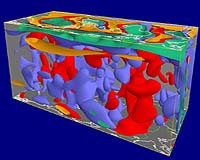
A team of scientists at CSIRO has developed a new exploration tool which could save oil and gas companies hundreds of millions of dollars. The Perth-based team has shown that by combining several different geological techniques they can predict where pools of oil and gas are contained (trapped) beneath the ocean floor. This is done by understanding a combination of factors including fault growth histories, trap geometry and hydrocarbon charge history, to predict the distribution of preserved and breached traps. Exploration in the Timor Sea has been difficult due to the large amount of fault activity and associated earthquakes over the last 10 million years. Fault movement can damage the structures that trap hydrocarbons by allowing the oil and gas to seep out through fractures. As a consequence of this process, exploration companies have spent millions of dollars drilling 'dry' wells. The model which has been tested against data in the Timor Sea has proven to have an accuracy rate of 80 per cent. CSIRO Project Leader Dr Anthony Gartrell says: "Of the 64 Timor Sea prospects we investigated, our model would have advised against drilling 42 of them. This would have saved industry approximately $400 million dollars. "Importantly, all of the commercial fields discovered in the area would have been high graded by the model. These hold hydrocarbon accumulations worth billions of dollars." The Fault Seal Team which was part of the Australian Petroleum Cooperative Research Centre (APCRC) Consortium believes the model addresses many of the problems that existing techniques can not. "Previous models don't take into account the way faults and stress fields evolve over time," says Dr Gartrell. The range of skills, experience and expertise across CSIRO divisions gives the organisation a broad capability to address the complex issues that arise in this region and many others. "By combining unique CSIRO techniques with standard industry methods, we have found an innovative solution in an area that has been explored for over 20 years," says Dr Gartrell. CSIRO Petroleum Division Chief Beverley Ronalds says: "This is a prime example of how science based solutions are helping to maintain a globally competitive and sustainable energy industry for Australia." Related Links CSIRO TerraDaily Search TerraDaily Subscribe To TerraDaily Express  New Laser Research Could Improve Oil Exploration Success
 Canberra (SPX) Feb 07, 2005
CSIRO Petroleum and German-based research centre Laser Zentrum Hannover eV (LZH) are collaborating in a project that could save millions of dollars in oil exploration and introduce new Australian geochemical and petroleum analysis techniques to Europe. |
|
|
| The content herein, unless otherwise known to be public domain, are Copyright 1995-2016 - Space Media Network. All websites are published in Australia and are solely subject to Australian law and governed by Fair Use principals for news reporting and research purposes. AFP, UPI and IANS news wire stories are copyright Agence France-Presse, United Press International and Indo-Asia News Service. ESA news reports are copyright European Space Agency. All NASA sourced material is public domain. Additional copyrights may apply in whole or part to other bona fide parties. Advertising does not imply endorsement, agreement or approval of any opinions, statements or information provided by Space Media Network on any Web page published or hosted by Space Media Network. Privacy Statement All images and articles appearing on Space Media Network have been edited or digitally altered in some way. Any requests to remove copyright material will be acted upon in a timely and appropriate manner. Any attempt to extort money from Space Media Network will be ignored and reported to Australian Law Enforcement Agencies as a potential case of financial fraud involving the use of a telephonic carriage device or postal service. |