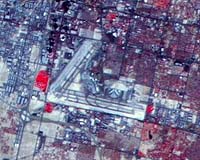
Las Vegas airport as seen from AlSAT-1 built by Surrey Satellite Technologies
Las Vegas airport as seen from AlSAT-1 built by Surrey Satellite Technologies |
Reviewing these early results, SSTL CEO, Professor Sir Martin Sweeting, said: "AlSAT-1 has met and exceeded our very high expectations, paving the way for the second DMC launch with three further satellites in July 2003. We are particularly pleased for our customer and DMC partner, CNTS, who have taken their first step into space with a truly innovative and important mission".
| Surrey Congratulates Australian FedSat Microsatellite Team Guildford - Apr 03, 2003 - SSTL congratulates the FedSat Team in Adelaide on their successful mission and is proud to have assisted in the Australian microsatellite project. SIL engineers, now employed at SSTL, were responsible for much of the design of the 50cm cube microsatellite, working on the project under a contract from the Cooperative Research Centre for Satellite Systems (CRCSS). SSTL, at the Surrey Space Centre, UK, provided technical support to the Australian team and manufactured a number of subsystems, including the spacecraft's four solar panels. Completion of the spacecraft primary structure was carried out at SSTL, as well as the tuning of the S-Band receivers, transmitters and duplexer units, all of which were designed and built at SIL. FedSat was launched into an 800km low Earth orbit onboard a Japanese National Space Development Agency HIIA launch vehicle on 14 December 2002. The satellite is being used to conduct a number of science, communications, remote sensing and engineering experiments and is being controlled from the CRCSS ground station in Adelaide. |
The constellation of SSTL-built satellites, when fully operational later this year, will allow DMC consortium members to retrieve 32-metre images of any point on the Earth in less than 24 hours � a service not presently available from any civil remote sensing system.
The DMC imagery, in partnership with Reuters AlertNet, will be available openly to serve the needs of the international disaster relief community.
As a national resource for Consortium members, each satellite will provide remote sensing services for such needs as agricultural monitoring, land use, urban planning, water resource management, coastal desertification and geological surveys.
Remote sensing experts at CNTS and the Surrey Space Centre will further explore key humanitarian and commercial applications of this unique and affordable imagery.
Sir Martin went on to say: "For more than 20 years Surrey has shown that microsatellites are increasingly able to perform useful and important missions. AlSAT-1 is further proof that services which once required satellites costing hundreds of millions of pounds can now be provided at an order of magnitude less cost. This is certain to change the economics of the remote-sensing industry".
Related Links
 Berkeley To Build Five Bird EO Constellation
  San Francisco - Apr 02, 2003